
 Printed on: October 6th, 2026
Communication skills: bridging physical and mental health
It is common for people to experience both physical and mental health problems concurrently. Persistent physical symptoms are common and can be highly distressing. We cover this topic in detail in the associated article on Persistent physical symptoms: a new approach to medically-unexplained symptoms. Many mental health conditions also involve distressing physical symptoms such as experiencing increased pain, fatigue and altered sleep in depression. Other individuals may develop comorbid mental and physical health conditions, or present with excessive anxiety, worry or preoccupation with their physical health such as in generalised anxiety disorder, health anxiety and body dysmorphic disorder.
For clinicians, it is important to develop skills in how to effectively manage this challenging and complex group of patients who may attend health settings repeatedly with concerns about both physical and mental health concerns, and may take up a disproportionate amount of time in primary care.
This article summarises some of the key communication skills that we can use to support people with physical and emotional symptoms.
References: BMJ 2019;364:l774, BMJ 2017;356:j268, BJGP Open 2017; 17X101061 and A competence framework for psychological interventions with people with persistent physical health conditions.
Be prepared
For complex patients with repeated attendances, it is helpful to prepare for the consultation by reviewing the person’s medical notes and letters.
If possible, create a brief summary and timeline for important medical and psychosocial events such as life events, medical investigations, hospital assessments and important diagnoses.

Improve continuity of care for complex patients
Where possible, aim for complex patients to see one ‘lead’ clinician with scheduled, longer appointments when needed, rather than ad-hoc appointments triggered by patient anxiety.
Practices can take a systematic approach to identifying relevant patients, and be aware of their distribution across GPs or other members of the practice team. It’s also important to support clinicians with regular practice meetings and multiprofessional case discussion.
Consider pathways for patient access to clinicians: is training needed for reception staff? What happens if the patient attends emergency or out-of-hours services? Creating clear guidelines in advance for how to cope with common patterns of symptoms or flare-ups can be extremely helpful.

Review in a longer appointment
Using a longer appointment to review the patient in detail may save time in the longer term. You could ask the person to prepare by writing some notes about their symptoms and concerns.
Be curious and use the time to explore their perspective, rather than rushing to offer rapid explanations or treatment suggestions.
This will help the patient feel that their concerns are being taken seriously, and provides a platform for moving towards the psychological aspects of the problem.

Build a strong relationship
Improving our relationship with patients is likely to lead to improved patient outcomes, and may even reduce stress levels for clinicians.
This involves giving our full attention during the consultation; expressing warmth, respect and concern; and using non-verbal communication strategies such as eye contact. Getting to know more about the person and exploring their perspective using active listening and open questions is also important.

Explore the physical symptoms and the patient ‘story’
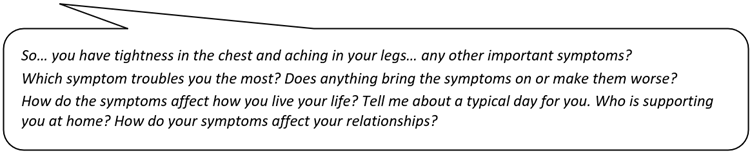
Use open questions to elicit a list of important symptoms, asking about duration, when they occur, triggers and what makes them better or worse.
For multiple symptoms, asking which ones are the worst can help to focus the history. Specifically ask about fatigue, pain and poor sleep.
Explore the functional impact of symptoms on the person’s work/education, social life, home life, activities of daily living, mobility and relationships with others. This could involve asking about a ‘typical day’.
Carry out a physical examination if appropriate.
Explore the impact of symptoms using a CBT framework
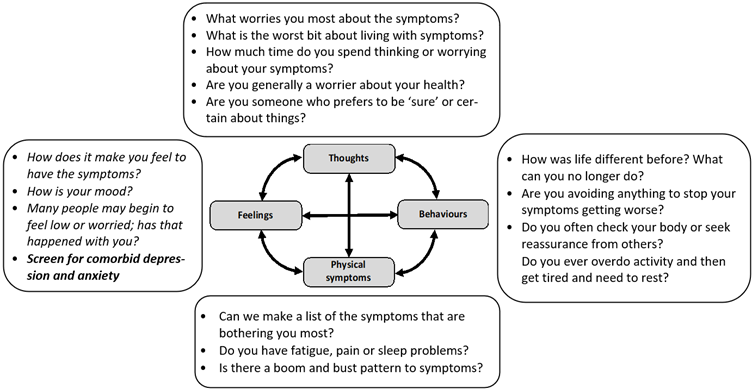
A CBT framework helps to create a structure for consultations with complex patients with mental and physical health problems. It can help identify their health beliefs and any unhelpful behaviours that may be maintaining the problem. Ask about the five different areas of the framework:
- Physical symptoms (it often helps to explore this first in people with concerns about their physical health).
- Thoughts and beliefs about the symptoms.
- Feelings and emotions.
- Behaviour, both helpful and unhelpful, in response to symptoms, including reduction in meaningful or enjoyable activities, ‘boom–bust’ activity patterns and anxiety-related behaviours such as reassurance-seeking, checking and avoidance.
- Environment, background factors and triggers for symptoms.
Offer empathy and compassion
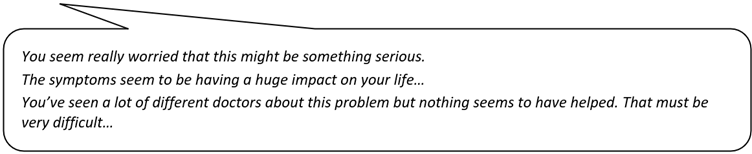
This is important. You can express empathy for the high levels of distress experienced by a patient even if you don’t necessarily agree with their reasoning and believe that their fears may be unrealistic or exaggerated.
You might also acknowledge the person’s frustration at being unable to resolve the issue despite repeated attendances.
Ask about family history of illness and adverse childhood experiences (ACES)
Physical or mental health conditions in close family members or during childhood may influence the person’s health beliefs or expectations.
It’s also important to ask about adverse childhood experiences (ACEs) which may make the individual more vulnerable to developing long-term conditions and complex health presentations, including persistent physical symptoms.

Minimise harm: avoid unnecessary tests or referrals
Carry out appropriate investigations, make referrals and offer treatments if clinically indicated, but avoid repeating these unnecessarily; this can lead to direct and indirect iatrogenic harm, increase patient anxiety and reinforce beliefs about the need for further intervention.
Try to predict likely negative results in advance as this can reduce subsequent anxiety.

Give clear explanations for symptoms
Acknowledge that symptoms are real and distressing. Where possible, give credible, concrete explanations that avoid jargon and are ‘blame-free’, and which can be linked to a mechanism in the body that makes sense to the patient.
Use words and concepts the patient uses themselves, and address their underlying beliefs and fears.
Offer support and next steps linked to your explanation, as well as providing supportive written information where possible.

Use a ‘twin-tracks’ approach to broaden the agenda
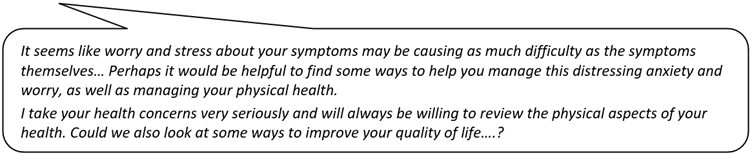
The next step involves broadening the agenda to include both physical health and emotional wellbeing. Our aim is to move away from a model of ‘find and cure’ for physical symptoms, and focus more on finding ways to live a fulfilling and meaningful life, even if symptoms are present.
Using a ‘twin-tracks’ approach can help to avoid black and white perspectives of a problem being either medical or psychological in nature. You can reassure the patient that you will continue to take their physical symptoms seriously, and that discussing emotional aspects of the problem does not mean you will assume that their symptoms are ‘all in their mind’.
Share the risk: acknowledge when you don’t know or are not sure
Be honest and clear about the existence of any uncertainty or risk. Don’t reassure unnecessarily or repeatedly as this may pull you into a vicious cycle which maintains anxiety.
You might find the article on Uncertainty in healthcare useful for this.

Focus on improving quality of life
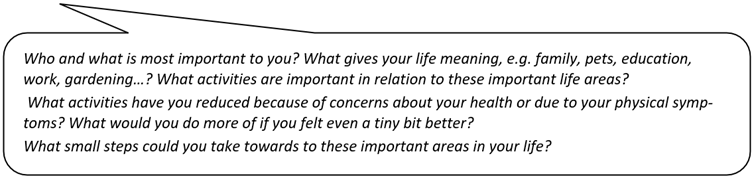
Increasing wellbeing through setting goals for small behavioural actions or ‘micro-goals’ that are likely to improve overall quality of life is important. This can move the consultation away from repetitive discussions about symptoms and their meaning, and shift towards a discussion about coping and even thriving in the face of physical symptoms.
Useful activities include physical activity, social interaction and relaxation.
 |
Communication skills: bridging physical and mental health Key skills for improving communication with patients with both physical and emotional health needs include:
|
 |
Select one patient to try out this approach with. How did it feel? Did it change the dynamic of the consultation? Reflect on this and, if you find it helpful, share these ideas with your colleagues!
|
This information is for use by clinicians for individual educational purposes, and should be used only within the context of the scope of your personal practice. It should not be shared or used for commercial purposes. If you wish to use our content for group or commercial purposes, you must contact us at sales@red-whale.co.uk to discuss licensing, otherwise you may be infringing our intellectual property rights.
Although we make reasonable efforts to update and check the information in our content is accurate at the date of publication or presentation, we make no representations, warranties or guarantees, whether express or implied, that the information in our products is accurate, complete or up to date.
This content is, of necessity, of a brief and general nature, and this should not replace your own good clinical judgment or be regarded as a substitute for taking professional advice in appropriate circumstances. In particular, check drug doses, side effects and interactions with the British National Formulary. Save insofar as any such liability cannot be excluded at law, we do not accept any liability for loss of any type caused by reliance on the information in these pages.
Here is the link to our terms of use.