 Premenstrual syndrome (PMS) and premenstrual dysphoric disorder (PMDD)
-
1. Premenstrual syndrome (PMS) and premenstrual dysphoric disorder (PMDD)
- 1.1 What is PMS?
- 1.2 What causes PMS?
- 1.3 What is premenstrual dysphoric disorder (PMDD)?
- 1.4 How common are premenstrual disorders?
- 1.5 Comorbidity with other mental health conditions
- 1.6 Making the diagnosis
- 1.7 Management of PMS
- 1.8 How does the management of PMDD differ from PMS?
- 1.9 Premenstrual exacerbations of mood disorders
 Printed on: June 15th, 2026
Premenstrual syndrome (PMS) and premenstrual dysphoric disorder (PMDD)
Premenstrual syndrome (PMS) and premenstrual dysphoric disorder (PMDD)
Around three-quarters of women experience some physical or emotional changes associated with their menstrual cycle (Br J Psych 2025;11:1). For many, these symptoms are mild, but when they become persistent, severe or disruptive, they may meet the criteria for premenstrual syndrome (PMS) or its more severe form, premenstrual dysphoric disorder (PMDD).
There are challenges around the management of PMS in primary care:
- The aetiology of PMS and PMDD remains incompletely understood, with no single established underlying cause.
- The evidence base for treatment is limited, particularly for PMDD, with relatively few high-quality trials.
- Few treatments are licensed specifically for PMS or PMDD, which makes management more complex and contributes to clinical uncertainty.
The RCOG has published a Green-Top Guideline on the management of PMS (RCOG 2017, GTG48). The National Association for Premenstrual Syndromes has also published guidelines on PMS (NAPS, 2018). Both include management of the full spectrum of premenstrual disorders.
This article was reviewed in January 2026.
What is PMS?
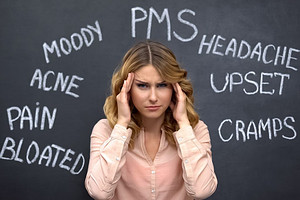
PMS is characterised by physical, psychological and behavioural symptoms that occur in the days leading up to menstruation and resolve by the end of menstruation.
Diagnosis is based on the cyclical timing of symptoms and their impact on daily functioning, rather than the specific symptoms experienced. To distinguish PMS from normal menstrual changes, symptoms must be severe enough to affect daily function or cause significant impairment at work, school or in relationships (RCOG 2017, GTG48).
More than 200 symptoms of PMS have been reported (BMJ 2011;342:d2994), including:
| Physical symptoms | Psychological and behavioural symptoms |
|
|
The International Society for Premenstrual Disorders (ISPMD) has defined a classification of different types of PMS (RCOG 2017, GTG48; BMJ 2011;342:d2994):
| Core premenstrual disorders |
|
| Variant premenstrual disorders |
|
What causes PMS?
We don't really know exact mechanisms, and it is not caused by one single factor. Key contributors include (Front Psychiatry 2024:15:1363875):
- Sensitivity to hormone changes. Hormone levels across the menstrual cycle are generally similar in women with and without PMS. Symptoms appear to arise from the way the brain responds to normal hormonal fluctuations, particularly changes in progesterone and its neuroactive metabolite allopregnanolone during the luteal phase. Rapid changes in hormone levels may be more important than absolute levels.
- Neurotransmitter dysregulation. Allopregnanolone acts on the GABA-A receptor in the brain, which helps to regulate emotional and stress responses. In PMS, the reduction in allopregnanolone levels during the premenstrual period may disrupt this regulation and contribute to anxiety, irritability, low mood and sensitivity to stress.
- Altered stress response. PMS is associated with dysregulation of the hypothalamic–pituitary–adrenal axis, with changes in cortisol responses and a greater reactivity to stress during the luteal phase.
- Changes in serotonin. There may be lower availability of serotonin and increased reuptake during the premenstrual period in women with PMS. This may help explain the therapeutic benefits of SSRIs.
- Inflammation and immune activation. There is some evidence of increased inflammatory markers such as CRP and cytokines in women with PMS. This may contribute especially to pain, bloating and somatic symptoms.
- Genetic factors. Family and twin studies suggest a heritable component, suggesting that some women may be biologically more sensitive to cyclical hormonal and neurochemical changes.
Other risk factors associated with the development of PMS and PMDD include (PLoS One 2023;18:e0278702):
- Rhesus-negative blood type.
- Higher caffeine consumption.
- Moderate or severe depressive symptoms.
- Younger age at menarche. Older age at menarche was associated with a reduced prevalence of PMS and PMDD, and appeared protective.
- Alcohol intake, particularly heavy drinking (BMJ Open 2018;8:e019490).
What is premenstrual dysphoric disorder (PMDD)?
Premenstrual dysphoric disorder (PMDD) is a severe form of PMS that has more significant psychological symptoms. Like PMS, symptoms occur in the luteal phase – typically the week before menstruation – and improve markedly or are absent in the week following menstruation.
To make the diagnosis, DSM-5-TR specifies that there should be five or more symptoms, including at least one core emotional symptom, in most menstrual cycles over the past year (APA, 2022). Symptoms must also cause significant distress or interfere with daily function:
| Core symptoms of PMDD (must include at least one of these) | Additional symptoms |
|
|
| (APA, 2022; J Aff Dis 2024;349:534) | |
Importantly, PMDD is also associated with high rates of suicidal ideation and attempts, with prevalence comparable to major depression. This has led to calls to explicitly include suicidality within the PMDD diagnostic criteria, and underscores the importance of routine suicide risk assessment for people presenting with severe premenstrual symptoms (Lancet Psychiatry 2025;12:90).
The diagnostic criteria of PMDD have also been criticised for focusing on psychological symptoms and putting less emphasis on physical symptoms, potentially excluding women with severe physical symptoms who do not meet full criteria (Cochrane Syst Rev 2024;8:CD001396).
Challenges in PMDD recognition and treatment
PMDD is a severe and debilitating condition affecting a significant number of women, yet it remains under-recognised and undertreated in clinical practice. One of the main challenges is the long delay in diagnosis, with some women waiting up to 20 years before receiving an accurate diagnosis or appropriate treatment. This contributes to increased psychological distress and may elevate the risk of suicidal ideation or attempts.
Lack of recognition of PMDD can also result in misdiagnoses, where women are incorrectly labelled with other mental health conditions such as bipolar disorder or borderline personality disorder, increasing frustration and delaying effective treatment. Gender inequalities in healthcare, combined with the historical neglect of women’s health issues, have also contributed to a lack of comprehensive research and treatment options tailored to the specific needs of women with PMDD.
The effects of PMDD can have a wide-ranging impact on women’s personal, social and professional lives, including:
- Increased absenteeism from work and reduced productivity, leading to lost wages, financial strain and higher healthcare costs.
- Impaired relationships and social isolation due to unpredictable symptoms and lack of empathy or understanding from others, including where the condition is dismissed or trivialised.
- Lack of recognition and validation from the medical profession, which can lead to distress and frustration, and the sense that difficulties are not being taken seriously. It also contributes to a cycle of dissatisfaction with care and delayed management of the condition.
How common are premenstrual disorders?
Up to 75% of menstruating individuals report some premenstrual symptoms, although many will not seek treatment or experience major functional impairment. The prevalence of clinically significant PMS is estimated at around 43–48% (Br J Psych 2025;11:1).
In contrast, PMDD is far less common, with approximately 1.6% of menstruating females meeting full DSM diagnostic criteria (J Aff Dis 2024;349:534).
Comorbidity with other mental health conditions
Both PMS and PMDD show high levels of comorbidity with other mental health conditions. Symptom overlap with conditions such as bipolar disorder and depression can make diagnosis more complex (Cochrane Syst Rev 2024;8:CD001396).
A systematic review and meta-analysis found that (Br J Psych 2025;11:1):
- Both PMDD and PMS commonly occur alongside mood disorders such as depression and bipolar disorder (particularly bipolar II), with around 40–45% co-occurrence of premenstrual and mood disorders.
- PMDD has a particularly strong relationship with mood disorders, and is more than 5x more common in females with bipolar disorder and 4.5x more common in females with mood disorders.
- This appears to be a bidirectional relationship, where premenstrual disorders can precede mood disorder onset, and a history of mood disorder can increase vulnerability to developing premenstrual symptoms.
- Comorbidity is associated with:
- Earlier age of onset of mood and premenstrual symptoms.
- More frequent or more severe depressive episodes.
- In bipolar disorder, higher rates of rapid cycling of mood.
- Greater functional and cognitive impact of symptoms.
Premenstrual exacerbations of mood disorders
Premenstrual exacerbation refers to the worsening of symptoms of an existing mood disorder such as depression or bipolar disorder in the premenstrual phase. This is distinct from PMDD and PMS, and it may be common, under-recognised and clinically important for the care of women diagnosed with mood disorders (Curr Psychiatry Rep 2021;23:78).
Around 60% of women with mood disorders experience premenstrual worsening of symptoms.
Making the diagnosis
History: timing is key!
We need to determine:
- Whether symptoms are truly premenstrual (i.e. is there a symptom-free period in the follicular phase) or is there an underlying disorder such as depression or irritable bowel.
- Care is needed to avoid wrongly diagnosing PMS in women with underlying psychiatric or somatic disorders NOT affected by the menstrual cycle.
- How much impairment do the symptoms cause?
- Is the patient taking hormonal treatment? Is contraception desired?
- What treatment does she want – if any?
- In severe symptoms or possible PMDD, risk assessment for suicidal thoughts and plans is essential (Lancet Psychiatry 2025;12:90).
Symptom diary
The RCOG recommends that diagnosis is based on a symptom diary kept for a minimum of 2 cycles. The daily record of severity of problems is widely used (and can be found in the appendix of the GTG) and another diary is available on the NAPS website.
PreMentricS is a smartphone app designed to enable women to track their PMS symptoms more easily, and may be useful diagnostically. Other smartphone symptom diary apps may do a similar thing.
If it is not clear whether PMS is the diagnosis…
A gynaecologist may offer a 3m course of gonadotrophin-releasing hormone (GnRH) analogue to confirm.
Management of PMS
We should offer first-line treatment in primary care, and refer to secondary care if this is not effective. The RCOG recommends that women with severe PMS should be managed by a multidisciplinary team, including a GP, gynaecologist, mental health professional and dietician.
Treatment choice will depend on suitability, tolerability, acceptability to patient and severity of condition. Management options include:
- Lifestyle.
- Psychological treatments.
- Hormonal treatments (to suppress ovulation and so reduce hormonal fluctuations).
- SSRI/SNRI (to increase serotonin levels in the brain).
- Surgery.
- Complementary therapies (an even less evidence-based option).
Treatment recommendations and supporting evidence are summarised below (RCOG 2017, GTG48):
| Management type | GTG recommendations | Evidence from GTG (and elsewhere where referenced) |
| First-line options (primary care) | ||
| Lifestyle |
|
|
SSRI/SNRI |
Offer SSRIs or SNRIs first line:
|
A Cochrane review (Cochrane 2024;8:CD001396) found that:
The RCOG bases its recommendation for SNRIs on a very small study which showed venlafaxine to be beneficial for PMS (J Clin Psychopharmacol 2004;24:540). |
| Combined hormonal contraception |
The RCOG recommends:
The FSRH recommends that:
So, we may wish to balance choice of agent against potential increased risk of VTE (and cost!) with newer formulations! |
Evidence showing efficacy of CHC for PMS is sparse; it is not clear what formulations and what regimens are the best.
|
| Psychological therapies | Offer CBT routinely to women with severe PMS symptoms. |
Data suggests that CBT can improve psychological symptoms (and avoids pharmacotherapy) in PMS and PMDD. CBT may also have reduced rates of recurrence compared with SSRIs (NAPS, 2018). |
| Complementary therapies |
Most products are not regulated for safety or efficacy, and are not licensed or registered for PMS treatment (discuss with patient). The following may be of benefit as part of a holistic approach:
A 2025 systematic review found that vitamin B6, calcium and zinc had significant positive effects on psychological symptoms of PMS, but there was insufficient evidence to support the effects of vitamin B1, vitamin D, whole-grain carbohydrates, soy isoflavones, dietary fatty acids, magnesium or multivitamins (Nutrit Rev 2025; 83:280). |
Evidence is conflicting; clinical trials are limited and very small.
|
| Second-line options (secondary care) | ||
Transdermal oestradiol |
Transdermal oestradiol (e.g. 100mcg patch) with cyclical progestogen (taken d17–28 for endometrial protection) is recommended for severe PMS.
|
A Cochrane review found (CD010503, 2017):
|
| GnRH analogues |
Result in complete suppression of the menstrual cycle. Due to hypoestrogenic side-effects and sequelae, they should only be used:
|
A meta-analysis found that:
|
| Diuretics | Spironolactone may be used to treat physical symptoms, BUT is potentially teratogenic (use effective contraception). | 2 small placebo-controlled trials (involving 35 and 28 women) suggest benefit. |
| Hysterectomy and bilateral salpingo-ophrectomy |
This is a permanent removal of ovarian cycles, and should only be undertaken in extremely severe cases when medical management has failed. HRT should be prescribed to women <45y. |
Observational data suggests high satisfaction rates in selected women. |
Treatments to avoid
- Low-dose danazol (200mg twice daily) has been shown to help with breast-related PMS symptoms, but side-effects include irreversible virilization.
- Progesterone or progestogens. Despite the fact that some progestogens (e.g. norethisterone, cyclogest pessaries) are licensed for treating PMS, there is no convincing evidence of benefit.
- There is currently no evidence to recommend the IUS alone as a treatment for PMS. However, despite this, your patient might think it worth a try – especially considering that lack of evidence of benefit would apply to most of our PMS treatment choices!
How does the management of PMDD differ from PMS?
The management of PMDD overlaps substantially with PMS. However, the evidence base specific to PMDD is even more limited than for PMS, and there is a lack of clear, dedicated guidelines for PMDD. Some key pointers for management include (Int J Womens Health 2022;14:1783):
- Have a low threshold for referral to specialist care for severe, refractory or complex cases.
- Routinely assess suicide risk whenever you review the patient, particularly in women with severe symptoms or marked functional impairment. See our article, Suicide, for more about how to approach this.
- Lifestyle changes: these may still play a supportive role in PMDD and should not be overlooked in favour of medication alone. Moderate aerobic exercise may be beneficial, although the evidence base is less robust than for pharmacological treatments (Best Prac Res Clin Endocrin Metab 2024;38:101858).
- Psychological therapies: CBT remains an important component of PMDD management, but is best viewed as complementary rather than an alternative to pharmacological treatment in moderate to severe cases. Evidence suggests that CBT can improve functioning and depressive symptoms in PMDD, even where core cyclical symptoms persist (Best Prac Res Clin Endocrin Metab 2024;38:101858).
- SSRIs are effective for PMDD and are often considered a first-line treatment. Starting doses are similar to those in anxiety and depression, although lower doses may also be effective for some. Symptom improvement can occur more rapidly in PMDD than in other mental health conditions, sometimes within 24–48h of starting treatment. There are no specific recommendations regarding choice of drug so local formularies can be followed. Note that, in the UK, no SSRIs are licensed for the treatment of PMDD and they are therefore prescribed off licence (Best Prac Res Clin Endocrin Metab 2024;38:101858).
- Hormonal treatments, particularly combined oral contraceptives, can be beneficial in PMDD, and may have a stronger evidence base for effectiveness than in PMS. The primary aim is to stabilise hormonal fluctuations through suppression of ovulation, rather than correction of overall hormone levels. Continuous regimens or shortened hormone-free intervals may further reduce symptom recurrence by limiting hormone withdrawal effects. However, hormonal treatments seem to be more effective for physical than emotional symptoms of PMDD, whereas SSRIs may be more helpful for mood (Front Psychiatry 2024:15:1363875).
- More intensive hormonal suppression strategies are reserved for severe PMDD, and require specialist guidance. GnRH agonists may be as effective as SSRIs in reducing symptoms, but are limited by significant adverse effects, including bone loss. Add-back hormone therapy remains controversial in PMDD because reintroducing progesterone or oestrogen may worsen mood symptoms in susceptible individuals (Front Psychiatry 2024:15:1363875).
Premenstrual exacerbations of mood disorders
Premenstrual exacerbation (PME) refers to a premenstrual worsening of an existing mood disorder such as depression or bipolar disorder. It is common, affecting around 60% of women with mood disorders, and is associated with a more severe illness course, greater functional impairment and higher relapse risk.
Important aspects of management include:
- Differentiating premenstrual exacerbation from PMDD. PME should be considered when premenstrual symptoms occur on the background of an ongoing mood disorder or are not confined to the premenstrual period (with a clear symptom-free interval). This distinction is important because treatments shown to be effective for PMDD, including hormonal treatments and ovulation suppression, have less evidence of efficacy for PME.
- Optimising treatment of the underlying mood disorder. Management should focus on effective treatment of the primary problem. Evidence is limited, but small studies suggest that temporary increases in antidepressant doses during the premenstrual period may reduce symptom worsening in some women with depression.
- Have a low threshold for specialist referral. This is particularly important if there are severe symptoms, a lack of response to treatment or where there is severe mental illness such as bipolar disorder.
(Curr Psychiatry Rep 2021;23:78)
 |
Premenstrual syndrome (PMS) and premenstrual dysphoric disorder (PMDD)
|
 |
Useful resources: |
This information is for use by clinicians for individual educational purposes, and should be used only within the context of the scope of your personal practice. It should not be shared or used for commercial purposes. If you wish to use our content for group or commercial purposes, you must contact us at sales@red-whale.co.uk to discuss licensing, otherwise you may be infringing our intellectual property rights.
Although we make reasonable efforts to update and check the information in our content is accurate at the date of publication or presentation, we make no representations, warranties or guarantees, whether express or implied, that the information in our products is accurate, complete or up to date.
This content is, of necessity, of a brief and general nature, and this should not replace your own good clinical judgment or be regarded as a substitute for taking professional advice in appropriate circumstances. In particular, check drug doses, side effects and interactions with the British National Formulary. Save insofar as any such liability cannot be excluded at law, we do not accept any liability for loss of any type caused by reliance on the information in these pages.
Here is the link to our terms of use.