
 Printed on: October 22nd, 2026
This Pearl is provided as free content. Here is the link to our terms of use
Carers: assessing and helping carers
Here are some statistics to focus the mind (British Geriatric Society – comprehensive geriatric assessment hub, accessed September 2025):
- Informal care is thought to be valued at £445 million a day – a similar amount to the costs of the NHS for a day
- After the age of 50y, the average person will spend more then 5 years providing informal care.
- 8% of UK households include someone who is an informal carer.
This article was updated in September 2026
What do we mean by ‘carer’?
Definitions vary! In this article, we are discussing the role of unpaid or informal carers.
An unpaid carer is "someone who provides unpaid support to a family member, partner, friend or neighbour who could not manage without their help because of illness, disability, frailty, a mental health condition or addiction. This includes both adult carers and young carers (under 18)" (NHS England - coding for unpaid carers: SNOMED CT).
There is no minimal threshold of time spent or responsibilities set to identify someone as a carer (Carers Support - who are carers?). This is different from eligibility for benefits, where Carer’s Allowance is paid to someone ≥16y who spends at least 35h a week caring for an eligible person (gov.uk - carer's allowance).
The rights of unpaid and informal carers are similar across the devolved nations (Care Act 2014, Carers Act Scotland 2021, Social Services and Well-being (Wales) Act 2014, Carers and Direct payments Act (Northern Ireland) 2002).
Caregiver stress and burnout
The British Geriatric Society, in its comprehensive geriatric assessment hub (accessed September 2025), reminds us of the issues related to carer stress. Although written with those caring for older people in mind, this applies to many caring situations:
- The stress perceived may relate to:
- Amount and type of care needed.
- Quality/dynamics of the relationship with the person being cared for prior to them needing care.
- Carer’s health.
- Support networks available to carer.
- Community expectations and societal value placed on caregiver role.
- Carer stress can present in a number of ways, including sleep disturbance, anxiety, low mood or depression.
- Carer stress can lead to resentment and, occasionally, harm and abuse.
The British Geriatric Society recommends a couple of tools that can be used to assess caregiver stress:
NICE guidance on support for adult carers
In 2020, NICE published guidance on how to support adult carers. Most of the guideline is relevant to those working in social care, but we have picked out areas where primary care may be able to play a role (NICE NG150 2020).
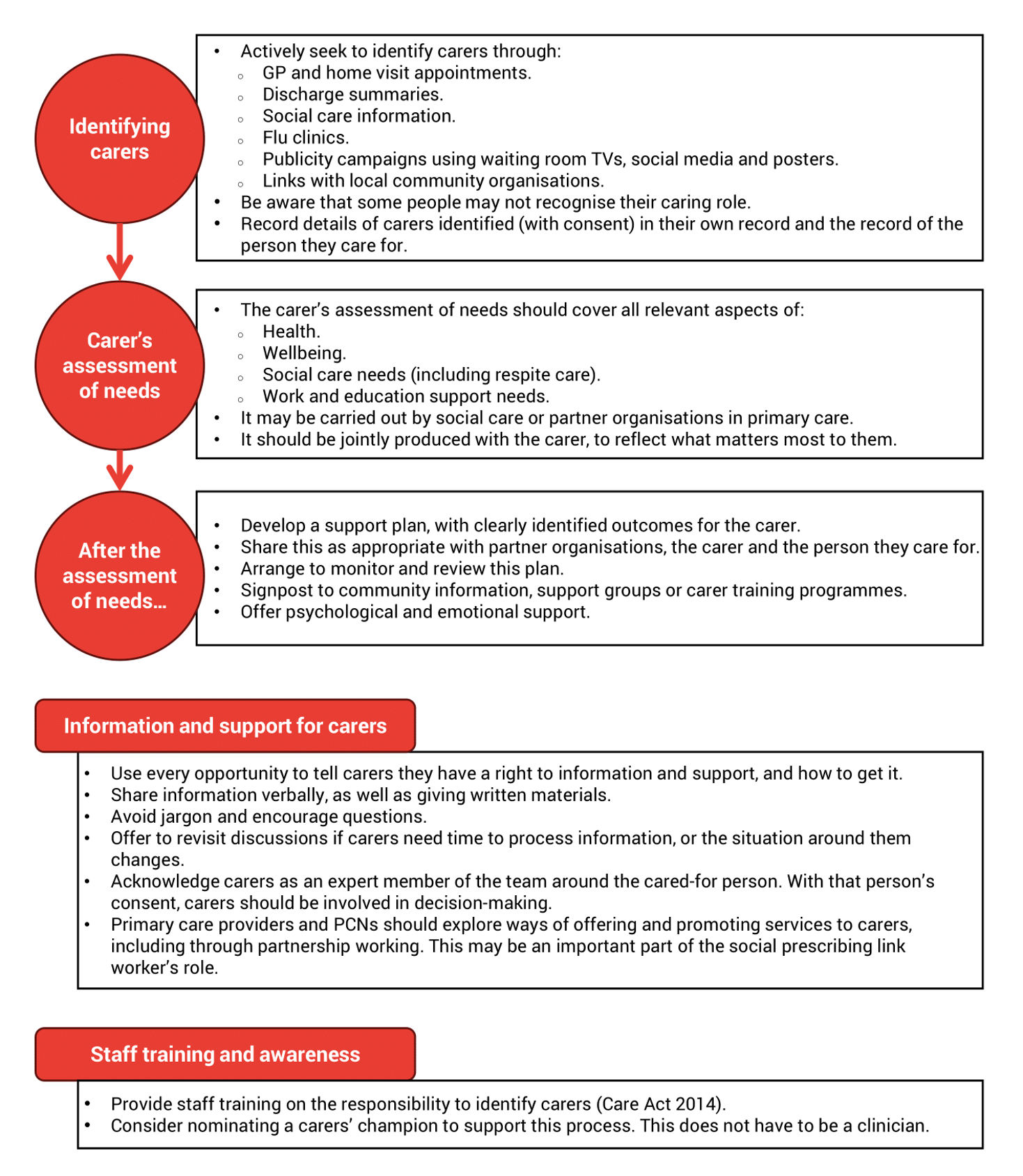
An older BMJ review looked at the challenges of healthcare professionals attempting to comprehensively assess carer needs. It suggested that while we may not have the time or skills to do a comprehensive assessment, we could focus on these components (BMJ 2011;343:d5202):
- Identify and code patients who have a major caring role (don’t forget young people who have caring roles for adults).
- Briefly assess their physical and mental health needs.
- Know where to signpost carers for local advice and support, e.g. regarding house adaptations, benefits, legal advice, carer education, respite care. This role may now be undertaken by social prescribing link workers.
- Help the carer to plan for emergencies.
- Develop a therapeutic relationship with the carer that is effective at listening and offering support.
Young carers
The 2021 census identified that there were 127 000 young carers (aged 5–18y) in England and Wales (BMJ 2025;390:r896). A study interviewed young carers to learn about their needs, and found that they valued the following 4 types of support (BMJ 2025;390:r896):
- Support for the person they cared for (usually a parent).
- Support for themselves.
- Mental health support.
- Support in school (understanding staff, time-out cards to leave early when needed).
In addition, young carers wanted:
- Easier access to services (e.g. referrals to appropriate services, help navigating what benefits were available, support when trying out a new service such as a young carers’ group).
- Having someone to talk to outside the immediate family so they could say things they couldn’t say to the person they cared for.
- Trust and confidentiality: to be able to talk to people who understood what they were living with and for sensitive information to be well managed. Some of the parents also feared social services, and worried that child protection services might make interventions.
- To be included in decision-making.
- For people to be proactive but not intrusive.
The authors concluded that to improve the experience, young carers needed:
- Improved support for those they cared for.
- Support for the whole family, based on strengths and needs.
- Accessible information about what support is available.
Remember, young carers (or their parents) can ask for a young carer assessment. This will focus on the needs and wishes of the young person, including time to do normal childhood things, schooling and homework, and needs of the person they care for.
 |
Carers: assessing and helping carers
|
 |
Do you identify carers at new patient registrations and annual dementia/medication reviews? Do you have a practice policy for identifying and coding carers? Do you have resources for carers within the surgery? Do you know where your local carers’ groups meet and how to contact them? |
 |
Useful resources: Websites (all resources are hyperlinked for ease of use in Red Whale Knowledge)
Useful resources for carers:
|
This information is for use by clinicians for individual educational purposes, and should be used only within the context of the scope of your personal practice. It should not be shared or used for commercial purposes. If you wish to use our content for group or commercial purposes, you must contact us at sales@red-whale.co.uk to discuss licensing, otherwise you may be infringing our intellectual property rights.
Although we make reasonable efforts to update and check the information in our content is accurate at the date of publication or presentation, we make no representations, warranties or guarantees, whether express or implied, that the information in our products is accurate, complete or up to date.
This content is, of necessity, of a brief and general nature, and this should not replace your own good clinical judgment or be regarded as a substitute for taking professional advice in appropriate circumstances. In particular, check drug doses, side effects and interactions with the British National Formulary. Save insofar as any such liability cannot be excluded at law, we do not accept any liability for loss of any type caused by reliance on the information in these pages.
Here is the link to our terms of use.