 Printed on: October 14th, 2026
This Pearl is provided as free content. Here is the link to our terms of use
Chronic pain: NICE guideline
NICE released its first guideline dealing with chronic pain in April 2021 (NICE 2021, NG193).
SIGN released part 1 of its chronic pain guideline in 2025 (SIGN 2025, 173). The second instalment is due in 2026.
We think the chronic pain guidance offers a real opportunity for change and to build more appropriate pathways of care for people with chronic pain, but it will take time for these pathways to emerge. We also cannot fail to acknowledge that the distress of chronic pain is commonly embedded in a web of social and societal issues, many of which are not directly in our control as primary care clinicians. This is difficult.
In this series of 3 articles, we aim to focus on what we can control and what is in our circle of influence while we wait for (or influence) care pathways to catch up.
- This article covers the nuts and bolts, focusing on the new NICE guidance.
- Chronic pain: communication skills and self-management will help to change the conversation, and offers lots of ideas for creating care plans.
- Finally, Chronic pain: opiates and dependence-forming medication offers some ideas as to how to avoid prescribing where it does not help, how to prescribe safely and effectively when it does help, and how to deprescribe where necessary.
This article was updated in June 2026.
What do we mean by chronic pain?
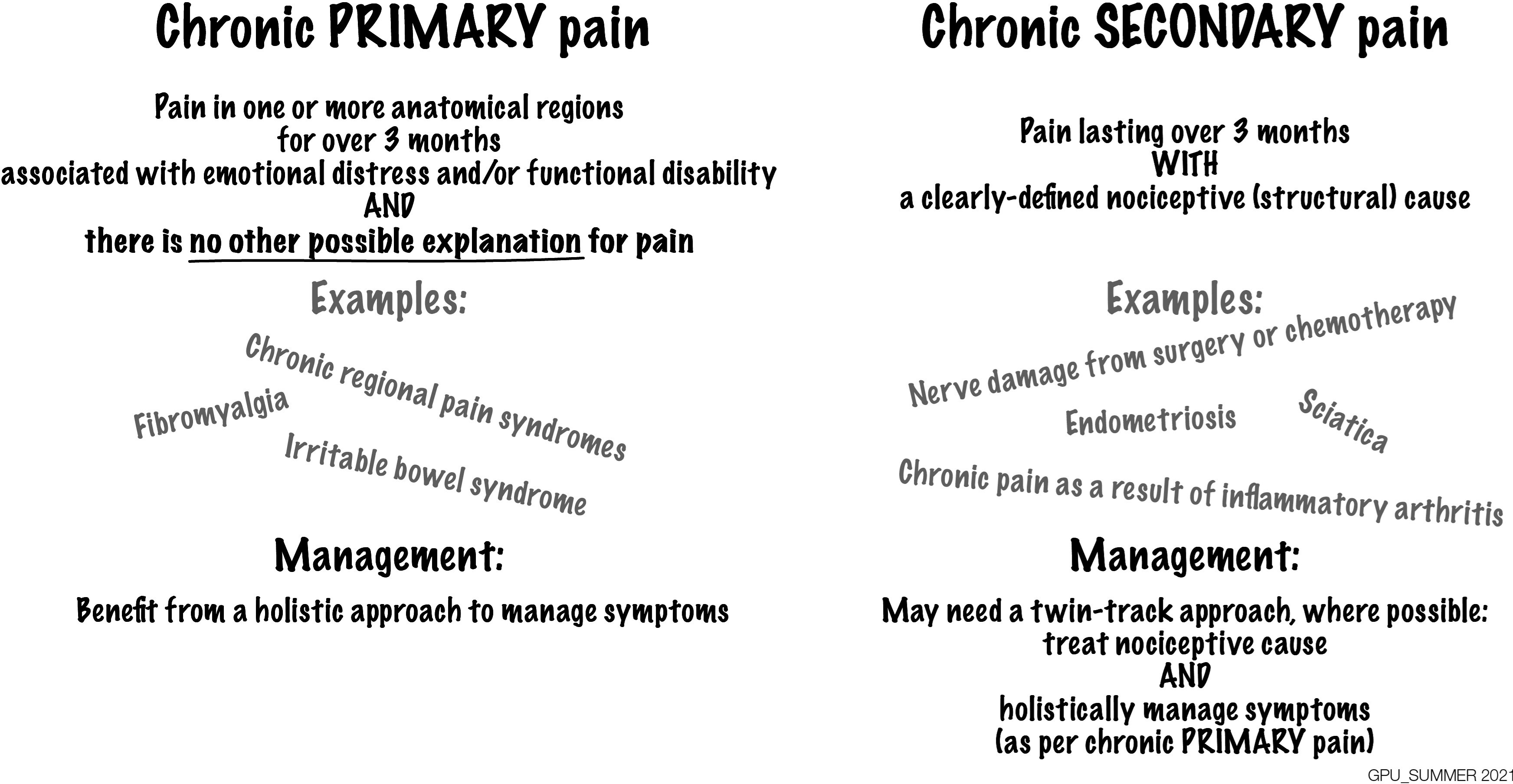
Pain becomes chronic when it has been present for over 3 months.
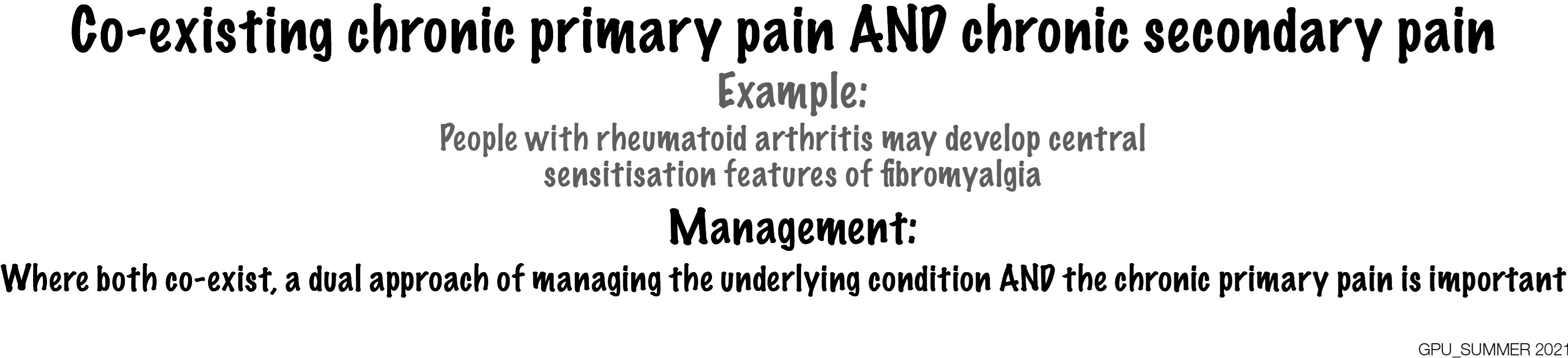
And, of course, chronic primary pain AND chronic secondary pain can co-exist:
However, NICE does not quite follow these traditional definitions: NICE defines chronic secondary pain as any painful condition for which there is an underlying diagnosis with pre-existing NICE guidance – thus, irritable bowel syndrome becomes chronic secondary pain, alongside those with chronic pain with osteoarthritis or rheumatoid arthritis. The bottom line: it wants us to follow the condition-specific guidance first.
Why does this matter?
- NICE sets out an holistic assessment process for ALL types of chronic pain (whether primary or secondary). One could argue that this assessment process is, in itself, therapeutic as it offers the opportunity for excellent communication, collaboration and coaching towards approaching self-management with confidence.
- NICE then defines treatments and makes specific recommendations for drugs that should not be initiated, which only apply to those with chronic PRIMARY pain.
Having said all that, NICE then reminds us that chronic primary and secondary pain can co-exist.
So, our dilemma is which treatments can you offer to which people, in line with NICE guidance? More on this in the section on management!
SIGN on chronic pain
The 2025 SIGN guidance is broadly aligned with NICE. We highlight the differences in the table below:
| NICE | SIGN | |
| Starting opioids | Do not do it. | In carefully-selected individuals only (NOT routinely). |
| Opiate dose thresholds | Not mentioned because they are not recommended in the first place! |
SIGN stratifies risk of harm using morphine equivalent dose/day:
|
| Pain management programmes | No recommendation made. | Recommended. |
| Acupuncture | Supported by NICE. | This will be in part 2 of the guidelines. |
NICE on the assessment of chronic pain
At Red Whale, we think this assessment is crucial. Of course, it is important to rule out other conditions. But critically, people need to feel heard and understood, and in doing so, it begins to change the conversation from “I need stronger painkillers” or “I need another scan” to acknowledging that distress may be affected by psychosocial factors, and that ‘treatment’ is more than pills or tests.
Doing this well may change the course of the illness…
| Assessing primary AND secondary chronic pain (NICE 2021, NG193) |
|
NICE on managing chronic pain
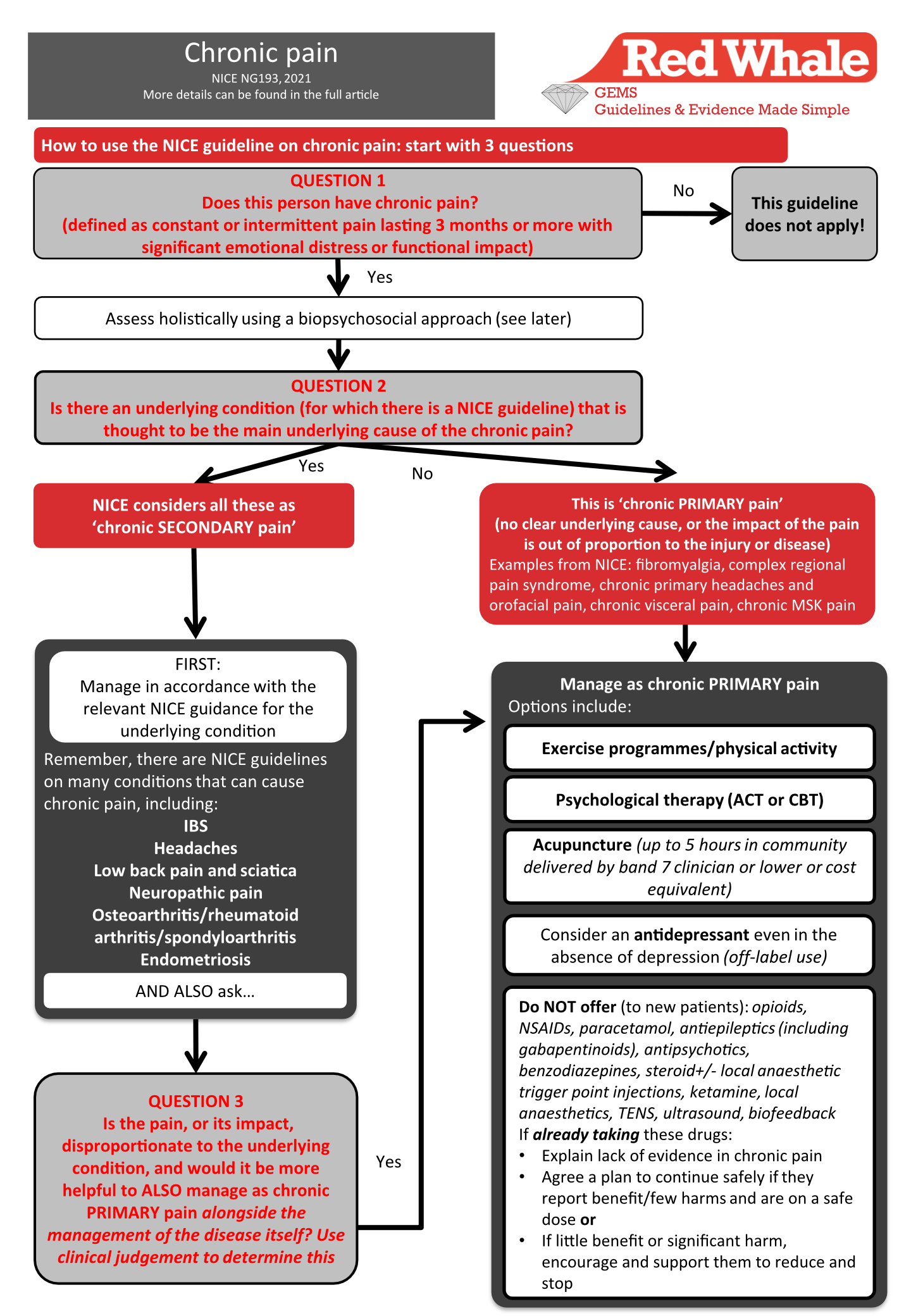
We think 3 questions can help us unpack how to use the NICE guideline on chronic pain, shown in the flowchart below. In particular, note that in chronic SECONDARY pain, we should manage the underlying condition as optimally as possible AND we should consider whether it would also be helpful to manage it as chronic PRIMARY pain too.
Please follow the link for a PDF version of the GEMS for download/printing: Chronic pain: GEMS
Managing chronic SECONDARY pain: summary of ANALGESIA interventions recommended by NICE
Here we summarise the ANALGESIA recommendations in each of the NICE/SIGN guidelines for the conditions listed. IMPORTANT! There are many non-analgesia treatments for all these conditions (see relevant articles in the online handbook for all of these).
| Chronic primary pain (NICE NG193, 2021) | |
| Opioids | Do not offer. |
| NSAIDs | |
| Paracetamol | |
| Antidepressants | Consider an antidepressant from: duloxetine, fluoxetine, paroxetine, citalopram, sertraline, amitriptyline. |
| Antiepileptics | Do not offer. |
| Low back pain/sciatica (NICE NG59, 2020) | |
| Opioids |
Do not offer opiates for:
|
| NSAIDs | Consider oral NSAIDs for low back pain and sciatica. |
| Paracetamol | Do not offer paracetamol alone (ineffective) for low back pain or sciatica. |
| Antidepressants |
|
| Antiepileptics | Do not offer gabapentinoids or any other anticonvulsant for low back pain or sciatica. |
| Headache and migraine (NICE CG150, 2015; SIGN 155: Migraine 2018) | |
| Opioids |
|
| NSAIDs |
|
| Paracetamol | |
| Antidepressants |
|
| Antiepileptics |
For migraine prophylaxis:
|
| Irritable bowel syndrome (NICE CG61, 2017) | |
| Opioids | No specific recommendation (but this could be considered a chronic primary pain so we would interpret as don’t use opiates!). |
| Antidepressants | Consider TCAs as second-line treatment; consider SSRIs only if TCAs are ineffective. See IBS article for more options. |
| Osteoarthritis (NICE 2022, NG226) | |
| Opioids | If NSAID/paracetamol insufficient, consider a weak opiate (ideally for flares – short duration with specific goals in mind). Do not routinely offer opioids (potential to cause adverse effects). |
| NSAIDs | Try topical NSAIDs first for knee/hand osteoarthritis. If paracetamol/topical NSAIDs are insufficient, consider an oral NSAID if not contraindicated. |
| Paracetamol | Do not routinely offer paracetamol (poor efficacy). Consider paracetamol in addition to core treatments (information/education, exercise, weight loss). |
| Neuropathic pain (excluding sciatica) | |
| Opioids | Consider tramadol ONLY as acute rescue therapy, not for long-term use. Avoid all other opiates outside specialist settings. |
| Antidepressants |
|
| Antiepileptics | |
Managing chronic PRIMARY pain
From NICE 2021, NG193.
Managing chronic PRIMARY pain | ||
Things we can offer… |
Things we should not offer… |
Things that need more research |
|
Do not start any other pharmacological intervention, including:
|
|
| What to do with people with chronic primary pain who are taking medications that are no longer recommended? | ||
|
Review prescribing as ‘part of shared decision-making’:
| ||
Frequently-asked questions on the NICE guideline
Why are all painkillers out for chronic primary pain?
In simple terms, because of an absence of evidence of long-term benefits and a body of evidence of short and long-term harms. NICE concludes that benefits do not outweigh the risks at population level (NICE 2021, NG193). However, importantly, it does make provision for continued prescribing for the individual who is already taking one of these medications at safe, stable dose, and who is gaining benefit and experiencing no side-effects.
Our challenge is to work with people to identify the best options for them – the related 2 articles offer lots of suggestions.
Why offer antidepressants and which one?
Remember: this is off-label if being used purely for the management of chronic primary pain in the hope that the antidepressant may improve sleep and quality of life (though we may well be treating a mood disorder as well, and should assess people with chronic pain specifically for anxiety and depression as both are more common than in the background population).
We should explicitly discuss the reason(s) for prescribing, and avoid people leaving feeling that we believe they are ‘just depressed’ or ‘making it up’.
NICE acknowledges that the evidence base is imperfect here, and the included studies predominantly relate to women with fibromyalgia where antidepressants have been shown to improve quality of life, pain and psychological distress (NICE 2021, NG193).
Duloxetine had a larger amount of evidence of long-term effectiveness in this setting than other drugs. However, there were no studies that compared different classes of antidepressant head to head, and while the effect size varies in placebo-controlled studies, NICE did not feel it could assume one class to be more or less beneficial than another.
Since NICE published the chronic pain guideline, there have been two noteworthy publications looking at antidepressant efficacy in chronic pain conditions. Both highlighted the lack of high-quality evidence for antidepressants in chronic pain.
- A synthesis of systematic reviews in the BMJ looked at 26 papers (including 156 unique trials and 22 pain conditions (BMJ 2023;380:e072415). It found that:
- None of the reviews demonstrated high-certainty evidence that antidepressants improved pain for any condition.
- Around 25% of the reviews demonstrated benefit with moderate-certainty evidence.
- Although tricyclics are the most commonly-prescribed antidepressant in pain conditions, evidence for their efficacy is inconclusive for most pain conditions.
An accompanying editorial made the observation that, for most living with chronic pain, antidepressant treatment will be disappointing (BMJ 2023;380:p170). This is important in view of NICE’s recent guidance on dependence-forming medications and antidepressants, which highlights the difficulties that some may encounter when stopping these medications (NICE 2022, NG215).
- A Cochrane review of antidepressants for pain concluded (Cochrane 2023(5):CD014682):
- There is an absence of data on the safety or long-term efficacy of antidepressants for chronic pain.
- The only antidepressant with certainty of efficacy in chronic pain is duloxetine, which was moderately efficacious at standard dose. However, we note that the review included over 6000 patients on duloxetine, and much smaller numbers for all the other drugs (the next largest data set was for milnacipran (3000 people) then amitriptyline (1800 people). 23 of the drugs studied had fewer than 500 people in the data set that was analysed.
The take home message?
There is a paucity of evidence for antidepressants in chronic pain. Duloxetine has the largest amount of data behind it, but, overall, as a class, the evidence of benefit is not overwhelming.
In making prescribing decisions, we need to weigh up the person’s preferences, comorbidities and other medication in making our choice. We should discuss that this is off-label use, and not be afraid to stop and reconsider/try an alternative if no emotional or functional improvement is seen.
What is acceptance and commitment therapy (ACT) and can we access it?
Acceptance and commitment therapy (ACT) is recommended by NICE alongside CBT as options for psychological therapy for chronic primary pain.
ACT is based on the idea of instead of fighting and reframing distressing thoughts and feelings, the alternative is to accept it but without giving up, being defeated or agreeing to the suffering. It uses mindfulness and values-based strategies to help manage and diffuse these thoughts and feelings.
Both ACT and CBT have been shown to improve quality of life, and ACT has also been shown to improve sleep, pain and psychological distress (in small studies). There was insufficient evidence for NICE to recommend one over another, and, while we may have access to both through IAPT, what is available locally is more likely to determine which we pick (NICE 2021, NG193).
What is the evidence for acupuncture?
NICE identified 27 studies that demonstrated reduced pain and improved quality of life when compared with ‘usual care’ or sham acupuncture in the short term (up to 3 months). There was insufficient evidence to determine longer-term benefits. Economic evaluation was taken into account in suggesting the maximum number of hours and band of healthcare professional who could deliver the intervention in a cost-effective way.
In practice, this means it is unlikely to be cost effective for a GP to deliver the intervention, but it may be cost effective for community-based physiotherapy or first-contact physiotherapy in primary care.
How do we create a personalised care plan for this?
You may well be screaming at this article right now, or feeling somewhat despondent. Don’t.
We cannot do all of this alone as individual clinicians working in our consulting rooms.
While we wait for commissioned services to catch up, we need to work together as primary care teams and, where possible, use multi-professional team resources; for example, clinical pharmacists may be able to support the tapering and deprescribing work; social prescribing link workers may be able to support self-management and access to third-sector resources, e.g. the Live Well With Pain Festival (see link below); first-contact physiotherapists may be able to support a plan for exercise, pacing and grading; and together, we can adopt a more holistic approach. The related articles focus on these areas.
Do the guidelines recommend cannabis for chronic pain?
No. Neither NICE nor SIGN recommend cannabis for chronic pain outside the context of a trial.
A Cochrane review looking at chronic neuropathic pain found no clear evidence for a beneficial effect of cannabis products (Cochrane Database Syst. Rev. 2026;CD012182).
Referral
Chronic pain services vary from region to region. Are you familiar with what your locality offers?
Historically, many pain clinics were highly interventional, providing joint (often spinal) injections, nerve blocks, epidurals and trigger point injections. Treatments were often repeated every few months.
More recent evidence has suggested that many of these interventions have low long-term clinical value and, as a result, chronic pain management has evolved. Multidisciplinary teams offering pain management programmes are recommended in NHS England service specifications. These teams may include:
- Consultant (usually an anaesthetist).
- Specialist nurse.
- Physiotherapist.
- Occupational therapist.
- Clinical psychologist.
- Clinical pharmacist.
The patient is also encouraged to be ‘part of the team’ – to foster collaborative approaches to management and shared responsibility, often with an acknowledgement that a ‘cure’ is an unlikely outcome for most.
What can I do while my patient is waiting?
Waiting times for NHS chronic pain services may be lengthy; these vary by region.
While waiting, there are some simple steps you may consider:
- It does take time, but an empathetic ‘long listen’ may be very valuable. This does not necessarily have to be with a GP, and this type of experience can be highly valuable for a registrar.
- Signpost to the excellent Live Well with Pain resource.
- Have an informative discussion (as appropriate) that chronic musculoskeletal pain is distressing, but does not cause damage. It may be uncomfortable, but it is safe to move. Sometimes, our patients need permission to do some of those things they miss in life.
- Resist the temptation to add or up-titrate unhelpful medications.
 |
Chronic pain: UK guidelines
|
 |
Discuss this guidance as a practice team, or even a PCN. How can different roles in the team best support people with chronic pain? Does your social prescribing link worker have access to good local resources, and are they aware of sites like Live Well With Pain? You may want to audit people with chronic primary pain (perhaps start with those with fibromyalgia). Compare their current treatment with these recommendations, and make a plan to flag the notes and discuss at their next review. If you have a clinical pharmacist, they may be able to help with this? |
 |
Useful resources for patients: Websites (all resource are hyperlinked for ease of use in Red Whale Knowledge)
|
This information is for use by clinicians for individual educational purposes, and should be used only within the context of the scope of your personal practice. It should not be shared or used for commercial purposes. If you wish to use our content for group or commercial purposes, you must contact us at sales@red-whale.co.uk to discuss licensing, otherwise you may be infringing our intellectual property rights.
Although we make reasonable efforts to update and check the information in our content is accurate at the date of publication or presentation, we make no representations, warranties or guarantees, whether express or implied, that the information in our products is accurate, complete or up to date.
This content is, of necessity, of a brief and general nature, and this should not replace your own good clinical judgment or be regarded as a substitute for taking professional advice in appropriate circumstances. In particular, check drug doses, side effects and interactions with the British National Formulary. Save insofar as any such liability cannot be excluded at law, we do not accept any liability for loss of any type caused by reliance on the information in these pages.
Here is the link to our terms of use.