
 Printed on: October 16th, 2026
This Pearl is provided as free content. Here is the link to our terms of use
Hyperhidrosis
“Doc, I’m so embarrassed. My sweating is out of control! I change my shirt twice a day, my shoes get ruined and I can’t write without making the paper wet…”
Hyperhidrosis is a chronic condition involving overreactive sweat glands. True prevalence is unknown because of underreporting and underdiagnosis. It can severely affect patients’ quality of life, relationships and work. This article is drawn from a BJGP Clinical Practice piece on the topic (BJGP 2024;74:236).
This article was updated in August 2026.
Causes and categories
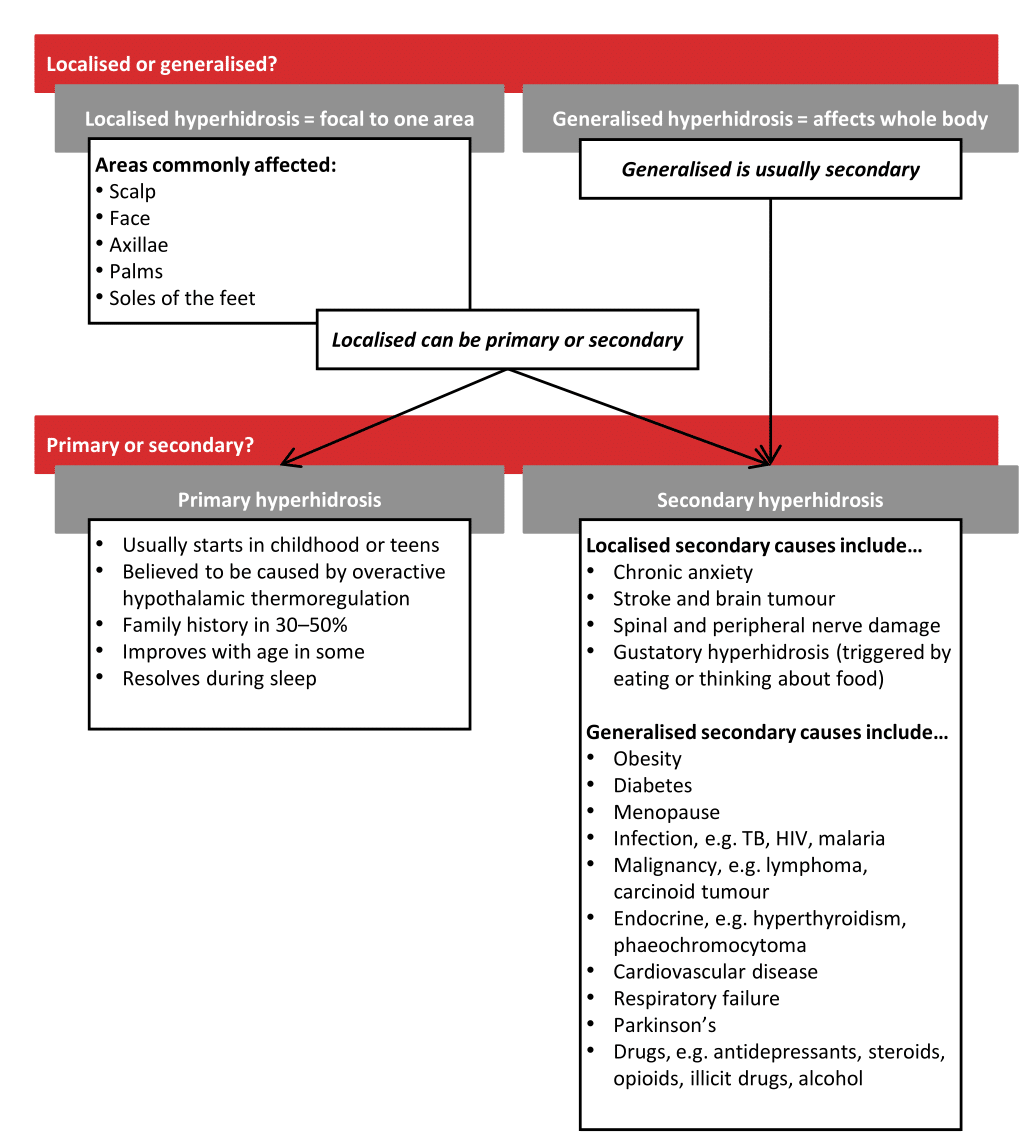
In 2024, a BJGP article suggested the following way for thinking about hyperhidrosis (BJGP 2024;74:236):
Assessment and investigation
The BJGP suggested (BJGP 2024;74:236):
-
History should include:
- Distribution of sweating, onset, timings and triggers.
- Psychosocial impact.
- Drug history, family history and comorbidities.
- Associated symptoms, e.g. weight loss, palpitations (if there are night sweats, be particularly cautious about excluding infection and malignancy).
-
Examination should look for:
- Signs of any underlying condition.
- Signs of any complications such as intertrigo or bacterial skin infection.
- If a specific secondary cause or causes are suspected, tailor investigations to these and refer as appropriate.
- If symptoms and signs are non-specific, the BJGP article suggests these investigations:
- FBC, U&Es, CRP, LFTs, TFTs, HbA1c.
- Chest X-ray.
Management
In 2024, the BJGP article suggested the following management strategies; we have also added information from the 2026 NICE TA on glycopyrronium bromide cream (BJGP 2024;74:236, NICE TA1175, 2026):
The BJGP doesn’t specify whether these management strategies are for primary or secondary hyperhidrosis, and we take this to mean that they can be used in either. The important thing to remember is that the treatment of secondary hyperhidrosis also involves addressing the underlying cause where possible!
| Simple patient-initiated measures |
|
|
Prescribable in primary care
|
|
| Secondary care (dermatology) |
|
What place for iontophoresis?
Iontophoresis involves passing an electric current through an ion-rich medium in which the affected part of the body is placed (or via pads for the axilla).
The BJGP review suggested that iontophoresis was available through secondary care, but the NICE TA says it is not available on the NHS. That means patients wishing to try this must buy/rent the devices themselves (they cost several hundred pounds to buy) (BJGP 2024;74:236, NICE TA1175, 2026).
Glycopyrronium bromide cream
The SPC tells us (EMC – product 101983):
- It is to be used in the armpits only, and is only licensed for adults (≥18y).
- Available as Anhidrox pump-pack 2.2mg/pump. Recommended dose is 2 pumps per armpit once daily for 4 weeks, then reduce to twice weekly, depending on amount of sweating. Each tube should last 1 month with daily use to both armpits. It costs £69.50 for a tube (NICE TA1175, 2026).
- IMPORTANT! The cream is pumped out onto the lid, NOT onto the fingers, and is applied to the armpits from the lid (to prevent topical absorption from fingers, or subsequent spread to eyes, nose and mouth). The effect lapses if you stop using it.
- Because it is an antimuscarinic, there are warnings about use in those for whom this might be an issue, including those with (EMC – product 101983):
- History of/at risk of urinary retention (e.g. severe prostatic hyperplasia).
- Coronary artery disease, CCF, arrhythmias and hypertension; however, significant cardiac antimuscarinic side-effects such as tachycardia are uncommon (1 in 100 to ≥1 in 1000)
- The commonest side-effect is a dry mouth (affecting more than 1 in 10).
Evidence on effectiveness and cost-effectiveness
The NICE TA tells us that (NICE TA1175, 2026):
- The evidence for effectiveness presented to NICE was two phase 3 RCT comparing the glycopyrronium cream with placebo.
- There were no clinical trials comparing the cream with oral antimuscarinics or botox, but indirect studies suggest the cream may be LESS effective than these treatments. However, it is cheaper than botox and some of the other secondary care options, and avoids the systemic side-effects of oral antimuscarinics.
 |
Hyperhidrosis
|
 |
Useful resources: |
This information is for use by clinicians for individual educational purposes, and should be used only within the context of the scope of your personal practice. It should not be shared or used for commercial purposes. If you wish to use our content for group or commercial purposes, you must contact us at sales@red-whale.co.uk to discuss licensing, otherwise you may be infringing our intellectual property rights.
Although we make reasonable efforts to update and check the information in our content is accurate at the date of publication or presentation, we make no representations, warranties or guarantees, whether express or implied, that the information in our products is accurate, complete or up to date.
This content is, of necessity, of a brief and general nature, and this should not replace your own good clinical judgment or be regarded as a substitute for taking professional advice in appropriate circumstances. In particular, check drug doses, side effects and interactions with the British National Formulary. Save insofar as any such liability cannot be excluded at law, we do not accept any liability for loss of any type caused by reliance on the information in these pages.
Here is the link to our terms of use.