 Printed on: October 14th, 2026
This Pearl is provided as free content. Here is the link to our terms of use
Osteoarthritis
- Osteoarthritis (OA) is a clinical condition thought to result from repeated ‘tear, flare and repair’ in a synovial joint.
- It is a leading and increasingly common cause of disability in an ageing population living with higher rates of obesity (Lancet 2019;393:1745, Arthritis Research UK, 2011, Hands on No 10).
- Health service costs are in the order of 1–2.5% of GDP (in part because of the costs of joint replacements).
- In addition, there are the indirect costs of disability to consider, e.g. time off work, early retirement.
This article was last updated in May 2026.
NICE on osteoarthritis
NICE issued an updated osteoarthritis guideline in 2022 (NICE 2022, NG226) which replaced its previous guidance (NICE 2014, CG177). We have summarised it below:
| Osteoarthritis in over-16s: diagnosis and management (NICE 2022, NG226) | |
| DIAGNOSIS | |
|
Diagnose osteoarthritis without imaging if:
Imaging may be used if there are atypical features or if an alternative or additional diagnosis is likely. | |
| INFORMATION AND SUPPORT | |
| |
| MANAGEMENT | |
| Non-drug treatments | |
|
Exercise
Weight management (if BMI ≥25)
Walking aids and devices
Manual therapy (manipulation, mobilisation or soft tissue techniques)
Some ‘do nots’
| |
| Pharmacological management | |
|
Drugs should be used alongside non-drug treatments to support exercise at the lowest effective dose for the shortest possible time. Remember: in NICE-speak, ‘offer’ is its strongest recommendation, while ‘consider’ is the weaker recommendation. | |
| First line | Topical NSAIDs (NICE says offer for knee OA and consider for all other OA). |
| Second line |
Oral NSAIDs: consider, if not contraindicated. Offer gastroprotection to all with OA if taking oral NSAID. Intra-articular corticosteroid injection: consider, if other drug treatments ineffective or unsuitable, or to support exercises. |
| ‘Do not do’ these things ROUTINELY… |
DO NOT routinely offer paracetamol (no benefit). DO NOT routinely offer weak opioids (harms). If other drugs are unsuitable, either of these options can be used for infrequent short courses. |
| ‘Do not do’ these things AT ALL… |
DO NOT offer glucosamine (no good evidence of effectiveness). DO NOT offer strong opioids (risks outweigh benefits). DO NOT offer intra-articular hyaluronan (no good evidence of benefit). |
| Review | |
|
Consider ‘patient-initiated follow-up’ for most living with OA, unless special circumstances:
| |
| Referral for joint replacement | |
|
Before referral for hip, knee or shoulder OA, establish that:
Use clinical assessment rather than numeric scoring systems when making a referral decision. Do not exclude people from referral due to age, sex, gender, smoking status, comorbidities or BMI, but explain that these factors can affect the risks of surgery. | |
Risk factors for osteoarthritis
Modifiable |
Non-modifiable |
|
Prior knee injury (knee OA). Obesity (weight-bearing AND non-weight-bearing joints). Knee extensor muscle weakness (quadriceps). Occupational, e.g. farming, construction. High-impact sports (dose-dependent). |
Genetic tendency. Female sex (not for hip). Advancing age. Knee malalignment. Congenital hip deformity. |
Obesity
- Being overweight or obese (BMI ≥25) doubles the lifetime risk of symptomatic OA. Why?
- Increases mechanical stress on the joint.
- Adipokines and other soluble mediators secreted by visceral adipose tissue increase pain and inflammation (NEJM 2024;391:1643).
- Obesity increases the risk of OA in both weight-bearing and non-weight-bearing joints, e.g. hand. Why would this happen? Obesity shouldn’t cause increased mechanical loading of the hand joints, should it?
- The ‘old’ model characterised OA as a non-inflammatory process: the result of ‘wear and tear’ (which would explain the knee OA). But we now know that there’s an inflammatory component. Adipose tissue is metabolically active and also secretes adipokines, which regulate inflammation, angiogenesis and fibrinolysis. There’s increasing evidence that the onset of OA is associated with obesity-induced adipokines (Frontiers in Immunology 2022;13:907750).
Prior injury
- Prior joint trauma such as ACL rupture accounts for 12% of knee OA cases.
- Knee OA that develops following anterior cruciate rupture may have a different mechanism of development from that associated with obesity; see below (JAMA 2021;325:568).
- Risk of osteoarthritis is not increased with recreational physical activity (NEJM 2021;384:51). Sport does not appear to cause osteoarthritis unless it causes a specific injury.
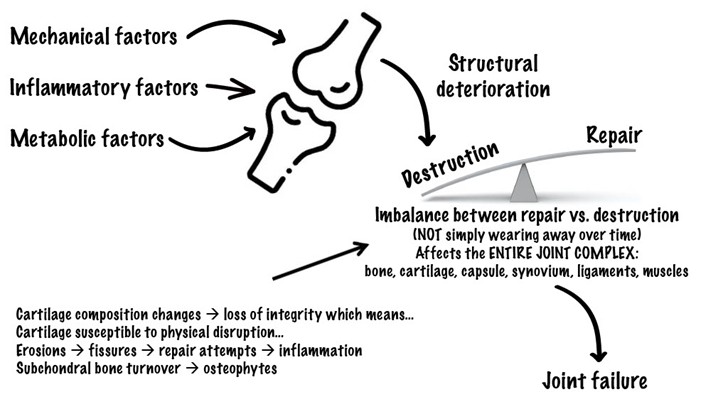
Why do we get osteoarthritis?
Understanding of the pathogenesis of osteoarthritis is evolving and is summarised in the diagram below (Lancet 2019;393:1745).
- OA is caused by a range of mechanisms leading to a common pathway of structural deterioration.
- Each risk factor may affect a different pathway (mechanical, inflammatory, metabolic).
- Each patient has a different mix of factors, e.g. the younger patient who develops knee OA following a cruciate rupture may have different causative mechanisms from the elderly patient.
- We should think of OA as a ‘whole joint disease’ involving the entire joint complex.
- We once thought of osteoarthritis as ‘the non-inflammatory type’ but synovitis (clinical, ultrasound or MRI) is commonly noted in osteoarthritic joints. This reflects activation of the innate immune response in the joint, and results in a ‘chronic wound’ environment. The synovitis in OA is more focal than in rheumatoid arthritis, where it is widespread (JAMA 2021;325:568).
Pain in osteoarthritis
There is no single thing that causes pain in patients with osteoarthritis. It’s not entirely clear where the pain comes from! Synovium and bone are richly innervated but intact cartilage is not. However, with the progression of OA, we see disruption of the cartilage (erosions and fissures) which brings neurovascular inputs into the deeper layers of cartilage. This, together with inflammatory and growth factors, could generate pain signals (nociceptive sensory input) (Annals Rheum Dis 2020;79:1105).
Pain in osteoarthritis is complex (Lancet 2019;393:1745):
- Peripheral nociception from tissue injury or inflammation is sent through peripheral nerves.
- This is ‘sorted’ at spinal cord level, then may be relayed to the brain.
- The brain processes this input (like a CPU) based on psychosocial comorbidity and socioeconomic circumstances.
- Our brain may conclude that we should feel pain, which is the output.
- Pain modifies our behaviour and may manifest as distress and disability.
Pain from knee OA is associated with younger age, female sex, non-white race, lower educational level, obesity, burden of coexisting conditions, psychological factors (e.g. depression, low level of self-efficacy and catastrophising) and pain sensitisation.
Pain sensitisation
With practice, our body gets good at ‘doing pain’:
- As disease progresses, increasing pain (perhaps not associated with any deterioration in radiographic severity of OA) may occur due to pain sensitisation, adaptations to chronic pain or reduction in activity to avoid pain (NEJM 2021;384:51).
- In patients with high symptom severity (painful) OA, pain thresholds are lower than in patients with low symptom severity (Osteoarthritis Cartilage 2015;23:1043).
Chronic pain
The image below shows an example of a patient who may decline into chronic pain. Can you identify the key danger signals such as unhelpful beliefs, fear-avoidance behaviour, catastrophising and factors which could positively feed back and compound the underlying problems? Where do you think this started? Are there opportunities for us to intervene?
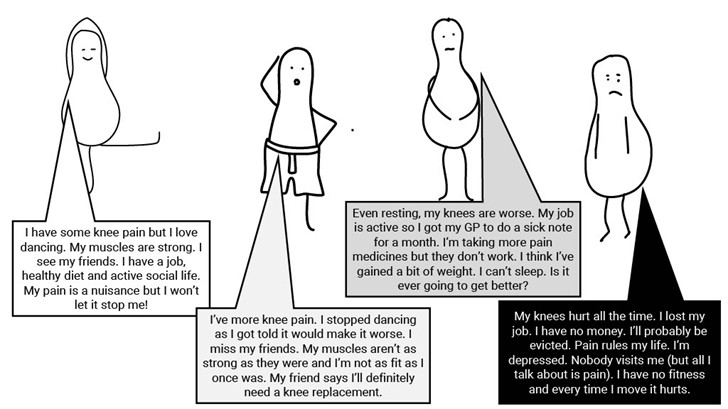
By definition, we have chronic pain at 12 weeks. This is chronic SECONDARY pain i.e. pain from an identifiable nociceptive cause (by contrast, an example of chronic primary pain would be fibromyalgia). The NICE chronic pain guideline (NICE 2021 NG193) reminds us to consider chronic pain management strategies in this group, particularly if the pain or its impact is disproportionate to the underlying cause. Check our articles on chronic pain for more information.
- Meta-analyses of pain management programmes show small to moderate effects in self-efficacy in patients with knee osteoarthritis. Pain-coping skills training targets catastrophising, which can otherwise lead to fear-avoidance of physical activity and reduce the likelihood of participation in other healthy behaviours (NEJM 2021 384;1:51).
Imaging in osteoarthritis?
The NICE guideline tells us (NICE NG226, 2022):
- Osteoarthritis is a clinical diagnosis.
- There is no evidence to suggest that imaging is beneficial for diagnosing OA. Imaging may be useful if atypical features that could suggest an alternative or additional diagnosis are present.
The Framingham Osteoarthritis Study showed (BMJ 2016;354:i3405):
- Many people with pain don’t have X-ray changes.
- Many people with X-ray changes don’t have pain.
There is a poor correlation between radiographic changes and reported pain.
MRI is rarely indicated in the assessment of knee or hip OA.
Information and support in osteoarthritis
NICE made specific recommendations about providing information and support to patients with osteoarthritis:
- Explain to patients that the diagnosis can be made without imaging.
- Provide information that offers hope for the future.
- Explain the core treatments to help people understand that drug treatments aren’t the answer.
- Teach patients to recognise flares and how OA pain can vary over time.
A BMJ article looked at improving discussions about OA in primary care (BMJ 2022;379:o2234). The take home messages were:
-
Patients said:
- Their condition and its impact weren’t taken seriously; they didn’t feel listened to; the doctors seemed hurried.
- They wanted tailored care, and clear and consistent information which was free of jargon.
-
Professionals said:
- Patients had unrealistic expectations and didn’t follow advice about weight loss or exercise.
- They recognised that education was important but didn’t prioritise it, and didn’t know how to advise on exercise.
-
The authors recommended:
- Professionals listen and validate patient concerns while treating people as individuals.
- Avoid negative terms such as ‘wear and tear’; instead, use positive messages to promote optimism.
Therapeutic exercise for osteoarthritis
NICE recommends therapeutic exercise as a core treatment for osteoarthritis (NICE 2022, NG226).
We need to be clear that, for the greatest benefit, this is joint-site-specific, rehabilitation-type exercise, rather than your ‘get off the sofa’ 150-minutes-a-week (although that is also likely to be helpful!).
It found:
- There is good evidence that exercise has clinically important benefits for people with OA, and a superior safety profile when compared with other treatments, e.g. analgesia.
- Exercise can help manage and reduce symptoms, and maintain or improve physical functioning over the long term.
- Shared decision-making is important; we can explain the benefit of exercise but acknowledge that, initially, it may be difficult and cause some discomfort.
- It’s important that we offer strong supportive messages that exercise is NOT harmful to osteoarthritic joints, and that regular exercise should reduce pain and increase function and quality of life over time. Let’s consider this further…
“Won’t exercise make my arthritis worse?”
At Red Whale, we think this question is critical. Can we deal with this inevitable question in a well-informed, confident manner?
Consider the 60-year-old dancer in the ‘pain in osteoarthritis’ diagram above who comes to see you…
She asks, “Should I stop dancing, doctor? Won’t it cause further damage to my painful knee?”.
What are you going to advise?
How will you convey this message while avoiding harmful language? Is this something you can practise?
Of course, the answer is: “YES! Continue to dance.”
It’s completely counter-intuitive, isn’t it? If we think it’s counter-intuitive, it’s entirely understandable that our patients would think that rest is best for a ‘worn-out’ body part…after all, you wouldn’t dream of taking your car out if it had a smoking engine and broken suspension!
The evidence suggests it’s the opposite story for your body: motion is lotion! (Cochrane Syst Rev 2018;4:CD010842). A systematic review of older adults with knee osteoarthritis showed no increase in pain and no progression of disease on imaging with exercise (Osteoarthritis Cartilage 2015;23:1445).
If you want to know more about this, see the link at the end of the article to the Flippin’ Pain webinar on YouTube – excellent stuff!
There are lots of free resources that our patients can use to access exercise programmes and pace their activity levels; see links in the useful resources box at the end of the article.
Weight loss for osteoarthritis
Weight loss is a core treatment (BMJ 2016;354:i3405):
- There is good evidence that weight reduction improves pain and disability in knee osteoarthritis (there is less evidence of impact on pain and disability in hip osteoarthritis).
- It improves surgical outcomes for all joint replacements.
Weight loss lowers the risk of OA and, in established disease, it relieves pain and slows the rate of cartilage loss. It reduces adipocytokine-mediated joint inflammation (NEJM 2024;391:1643).
NICE noted that losing 10% of body weight is likely to have better outcomes than 5%, and advised this to provide an incentive to encourage weight loss. In addition, a specific goal was thought to provide a target to work towards. Most of the evidence related to knee osteoarthritis, but NICE stated that it had determined it was applicable to other joints because weight loss would reduce inflammatory factors and improve general wellbeing.
GLP-1 mimetics for osteoarthritis
GLP-1 receptor agonists help weight loss, but they also have some anti-inflammatory and immune-modifying effects. The GLP-1 receptor is present in synovium, bone and cartilage. The mechanisms are not yet fully understood, but it’s likely that there is some additional factor ‘X’ over and above the benefits expected from the weight loss alone (NEJM 2024;391:1643).
This factor ‘X’ has already been observed in some of the cardiovascular trials where participants receiving the GLP-1 mimetic have superior outcomes to those with similar amounts of weight loss without GLP-1 mimetic (Lancet 2018;392:1519).
Regardless of mechanism, evidence is mounting that GLP-1 mimetics help reduce pain in osteoarthritis. A double-blind RCT (the STEP9 trial) comparing once-weekly subcutaneous semaglutide with placebo found a striking analgesic benefit associated with substantial weight reduction.
The trial recruited over 400 participants with at least moderate knee OA and a BMI ≥30. They were followed-up for 68 weeks. Those in the semaglutide arm had a mean change in body weight of around -14%. This was associated with large improvements in median pain scores and improvement in physical function scores. Adverse event rates were similar across both groups.
There wasn’t an arm in this trial comparing non-GLP-1-mediated weight reduction with GLP-1-mediated weight reduction (which would have explored that factor ‘X’). It is worth noting that the STEP9 trial was funded by Novo Nordisk (NEJM 2024;391:1573).
A similar trial using liraglutide showed no significant reduction in pain compared with placebo, but, in this trial, the weight reduction was less pronounced, with only a mean -2.8kg weight loss in the treatment group (Am J Clin Nutr 2021;113:314).
Walking aids for osteoarthritis
NICE recommends the use of walking aids, e.g. walking stick, for lower limb osteoarthritis (NICE 2022, NG226). It determined that walking aids may reduce pressure in the leg joints, thus supporting exercise while improving confidence in walking. This may be especially useful in those waiting for joint replacement or deemed unfit for surgery.
A tiny Brazilian RCT of individuals with knee OA randomised people to a walking stick (and a 5min session from a physio on how to use it) or no stick (Arch Rheum Dis 2012;71:172):
- The walking stick group had less pain and better quality of life (pain scores had improved more than would be achieved through any other non-surgical intervention!).
How many of us can advise our patients correctly about walking sticks?
Which hand should it be in? How long should the stick be?
If it makes you feel any better, I didn’t know either…
- With the patient standing up straight, with arms by their side, the stick should come to the distal wrist crease. This means that, when the patient stands holding the stick, their elbow is flexed by 20–30°.
- The stick should be used on the opposite side to the affected knee because this means the arm swings with the affected knee, maintaining a normal gait pattern, and the stick shares the load with the knee.
Analgesia for OA
- There is no tablet that will cure osteoarthritis.
- Exercises to strengthen the muscles supporting the knee and hip have greater benefits on pain and disability than any analgesia.
However, NICE suggests that drug treatments may be useful for reducing symptoms and supporting people to start a more effective treatment such as therapeutic exercise. All drug treatments should be used for the shortest possible time at the minimum effective dose; NICE recommends (NICE 2022, NG226):
| First line | Topical NSAIDs (NICE says offer for knee OA and consider for all other OA). |
| Second line |
Oral NSAIDs: consider, if not contraindicated. Offer gastroprotection to all with OA if taking oral NSAID. Intra-articular corticosteroid injection: consider, if other drug treatments ineffective or unsuitable, or to support exercises. |
| ‘Do not do’ these things ROUTINELY… |
DO NOT routinely offer paracetamol (no benefit). DO NOT routinely offer weak opioids (harms). If other drugs are unsuitable, either of these options can be used for infrequent short courses. |
| ‘Do not do’ these things AT ALL… |
DO NOT offer glucosamine (no good evidence of effectiveness). DO NOT offer strong opioids (risks outweigh benefits). DO NOT offer intra-articular hyaluronan (no good evidence of benefit). |
Why topical NSAIDs first line?
- Older studies have demonstrated that for knee and hand osteoarthritis (but not hip), topical NSAIDs are as effective as oral NSAIDs and have fewer side-effects – they should be considered first line (BMJ 2008;336:138).
- So far, no serious gastrointestinal or renal side-effects have been demonstrated (Lancet 2019;393:1745).
- The BNF lists, as caution, that, “topical application of large amounts can result in systemic effects, including hypersensitivity and asthma (renal disease has also been reported) (in adults)” (NICE BNF - ibuprofen, accessed May 2023).
- They are the most cost-effective medication for OA; most evidence came from knee and hand OA (NICE 2022, NG226).
- NOTE: in the appendices to the guideline, NICE discussed topical capsaicin. There was some evidence that it reduced pain in knee OA, but not in hand OA. It was more expensive than topical NSAIDs. There was no recommendation made regarding capsaicin; it simply wasn’t mentioned in the main guideline.
Oral NSAIDs
NICE found that oral NSAIDs were cost-effective, resulting in slightly reduced pain and increased function (NICE 2022, NG226). It acknowledged the well-established risks (GI, cardiovascular, liver, renal) and suggested PPI was used in all patients.
Opiates
- A systematic review and meta-analysis in the BMJ looking at 192 trials and over 100 000 patients with hip and knee OA concluded that any benefits of opioids, regardless of preparation or dose, failed to outweigh the harms (BMJ 2021;375:n2321).
- Tramadol is often seen as ‘opiate-lite’ but there is a good body of evidence now emerging that this is not the case. In the management of osteoarthritis, a large cohort study of nearly 90 000 patients demonstrated an association between increased mortality at 1y in patients prescribed tramadol compared with an initial prescription of NSAIDs. This is an association; causation cannot be determined, and the result may reflect the underlying comorbidities of patients in whom we choose a mild opiate rather than NSAID (JAMA 2019;321:969).
Why no paracetamol?
NICE does not recommend routine use of paracetamol in the OA guideline (NICE 2022, NG226). It determined that paracetamol is no better than placebo for hip and knee pain (there was some benefit but it was clinically insignificant). That said, NICE does recognise that some of our patients are unable to use NSAIDs, and suggest it’s a reasonable option under these circumstances.
Other drugs
Duloxetine reduces pain in knee OA significantly more than placebo in RCTs (JAMA 2021;325:568) but is not in the NICE osteoarthritis guideline (NICE 2022, NG226). If the pain is chronic, NICE reminds us that we can adopt some of the management from its chronic pain guideline (NICE 2021, NG193), which does allow us to consider antidepressant therapy (even in the absence of depression). Duloxetine may be particularly helpful in those with widespread pain or depression.
A double-blind RCT in New Zealand assessed a tricyclic antidepressant (nortriptyline) for analgesia in knee osteoarthritis. No significant benefit was found and the adverse effect profile was in line with expectations (BJGP 2021;e538).
Osteoarthritis flares
This topic was the subject of a BMJ Practice Pointer article (BMJ 2023;383:e076455).
A flare of osteoarthritis is a “transient state, different from the usual state of the condition, with a duration of a few days, characterised by onset, worsening of pain, swelling, stiffness, impact on sleep, activity, functioning, and psychological aspects that can resolve spontaneously or lead to a need to adjust therapy”.
- Flares last, on average, 3–8 days.
- Imaging is not required unless features are atypical.
- Differentials include a crystal arthropathy, septic arthritis, rheumatoid arthritis, trauma, malignancy.
- Triggers may include:
- Knee giving way, potentially caused by pain, instability or lack of muscle strength – another reason for good physio!
- Increased physical activity: squatting, kneeling, going up and down ladders.
- Psychosocial factors: mood or poor sleep, catastrophic thinking.
- Environmental factors: cold and damp weather.
Flare management
There is limited evidence to guide flare management. A key underlying principle is to ‘set out our stall early’: tell our patients to expect flares and to promote self-management. We can encourage our patients to self-identify their own triggers and modify behaviour accordingly.
How will you explain this to your patients? Consider developing your own ‘patter’. Mine goes along these lines, and I sometimes find a sketch graph can help:
“We sometimes think that osteoarthritis will give us pain and stiffness constantly (straight line on sketch graph), but, in reality, it’s more like this (bumpy line on graph), with times when symptoms get worse. There are often long periods when symptoms settle back down: good days, bad days; good weeks, bad weeks. Sometimes, something sets off a flare, like a stumble, running for a bus or an unexpectedly long walk (after you missed that bus!). Sometimes, a flare just starts for no reason. What we DO know is that, most of the time, a flare will settle back down in a few days. You might need to rest a bit, and use a little more of your medication, but we expect flares. The important thing is that you get back to doing your usual things once it’s settled – but, if you find that there’s something that always sets you off (like kneeling), it’s probably best to avoid that!”
The authors of the article suggest:
- Modify activity and behaviour to help prevent or reduce flare frequency:
- Short-term relative rest may be helpful while symptoms are severe.
- Encourage a return to activity as symptoms settle.
- Exercise-related flares may become less frequent after graded exercise because exercise tolerance develops.
- Analgesia to rapidly reduce the impact of a flare. This is different from chronic OA management. Options include:
- Topical or oral NSAIDs.
- Corticosteroid injection (if a flare does not settle as expected).
- Consideration of paracetamol or weak opioid (for shortest duration, at lowest effective dose).
- The following require further research before being adopted: oral or IM corticosteroid, hyaluronan injection.
- If a flare becomes protracted, it may be progression of the underlying OA. Consider escalation of care in line with the NICE OA guideline.
Disease-modifying treatment for osteoarthritis
This has been an area of intense research activity but, as yet, no disease-modifying treatment has been demonstrated to have significant benefits, and no drug has been licensed for this purpose.
The HERO trial looked at hydroxychloroquine in hand osteoarthritis but did not show any significant effect over placebo (Osteoarthritis Cartilage 2017;S1-S7:53).
The Australian METHODS trial looked at methotrexate to treat hand osteoarthritis with synovitis. This was a double-blind, randomised, placebo-controlled trial in 200 participants. After 6 months, there was a moderate difference in visual-analogue scale pain score, which was just clinically significant. The authors felt this was proof of concept (Lancet 2023;402:1764).
A 2022 network meta-analysis in the DTB evaluated the use of 12 drugs and herbal remedies, looking for evidence of benefit on progression of hip and knee osteoarthritis (DTB 2022;60:4). The drugs it looked at were diacerein, bisphosphonates, strontium, doxycycline, licofelone (a lipoxygenase/COX-inhibitor), inducible nitric oxide synthase inhibitors and matrix metalloprotease inhibitors. There was no evidence of clinically meaningful benefit on joint structure, pain or function for any of these treatments.
Alternative oral remedies for osteoarthritis
Although herbal and alternative remedies are widely used by our patients with OA, there is no meaningful evidence that any of the following have lasting benefit over placebo in terms of joint structure, pain or function. However, they CAN interact with other medication so ask about their use!
The DTB has assessed several compounds, including avocado/soybean unsaponifiables, Indian frankincense (Boswellia serrata), rosehip (Rosa canina), vitamin D, vitamin E, chondroitin and turmeric (DTB 2012;50:8, DTB 2022;60:4).
Krill oil was also found to be ineffective for pain in knee osteoarthritis with effusion synovitis (JAMA 2024;331:1997). Krill are small shrimp-like crustaceans and have oil in them, like fish do. (Evidence for fish oils being beneficial in OA is also poor.)
Our patients often ask about glucosamine but the evidence is underwhelming, it isn’t cost-effective and it isn’t recommended by NICE (NICE 2022, NG226).
As clinicians, we may take the view that these remedies are unlikely to do harm, but we must consider the financial harm to our patients, many of whom may lack disposable income to spend on things which have clear evidence of absence of benefit.
Intra-articular steroid injections
NICE recommended that intra-articular corticosteroid could be performed for OA if (NICE 2022, NG226):
- Other treatments have not helped.
- The patient understands that the benefits are likely to be short-lived (2–10 weeks).
- Injection supports people to participate in therapeutic exercise (where possible).
NICE found that the evidence base for treatment was far from conclusive, and studies were small and heterogeneous.
Corticosteroid injection for knee osteoarthritis
A BMJ Uncertainties article (BMJ 2020;368:6923) looked at the evidence and found that intra-articular steroids for knee osteoarthritis may:
- At best, improve pain and function in the short term (<8 weeks), but any benefit is not usually sustained beyond 3 months (consistent with the NICE 2022 recommendations).
- Confer a small risk of joint deterioration (thinning of cartilage) and worsening symptoms over the long term, and this is increased with repeat injections.
What does this mean in practice?
We have to weigh the short-term benefits of corticosteroid injections for knee osteoarthritis against potential longer-term harms. The author argues they may have a place in the frail elderly where a joint replacement may not be an option. However, for younger and middle-aged patients, the longer-term consequences may be more important. Active treatments, particularly weight loss and exercise, should be prioritised.
Corticosteroid injection for hip osteoarthritis
A well-designed, UK primary care-based RCT studied 199 patients with clinically-moderate hip OA (BMJ 2022;377:e068446). They all received standard treatment (advice and education) but were randomised to either ultrasound-guided plain local anaesthetic hip injection OR ultrasound-guided local anaesthetic PLUS corticosteroid injection. The primary outcome was self-reported hip pain score at intervals over 6 months.
- Patients in the intervention group halved their pain score at 2 weeks, with a mean 25% improvement at 6 months.
- At two months: NNT = 2 for no sleep disturbance, NNT = 3 for ‘feeling better’, NNT = 3 for ‘no limits to usual activities’.
- At six months: NNT = 3 for ‘would have same treatment again’ (BMJ 2022;377:o1028).
- Those noted to have ultrasound-confirmed synovitis or hip effusion benefitted the most from the injection.
The authors concluded that ultrasound-guided intra-articular hip injection of corticosteroid is a viable treatment option for hip OA.
What does this mean in practice?
The NNTs in this study are remarkable.
Intra-articular hip injection usually needs imaging (ultrasound or fluoroscopy) so we’re going to need to refer:
- Are you able to refer directly to radiology on ICE for this, or do you have to use a local MSK or orthopaedic service?
-
Who might be the best candidates? Hip injections aren’t part of routine care but it could be a useful ‘tool in the box’:
- Consider those patients not fit enough for surgery due to comorbidity?
- Consider those who don’t want surgery or have been told they’re “too young” and “come back in 5 years”?
- Consider someone who wants to manage the condition medically for a period of time, e.g. until retirement, or while caring for family?
The trial also found that the injection worked best in those with baseline synovitis or effusion. The accompanying editorial (BMJ 2022;377:o1028) notes that:
- This justifies the tear, flare and repair model of osteoarthritis and the anti-inflammatory injection strategy, i.e. steroid acts primarily as an anti-inflammatory.
- This further discredits the ‘wear and tear’ model, which was “negatively framed, inconsistent with evidence and advice about physical activity, and is woefully inaccurate, reinforcing expectations of inevitable decline and reduced quality of life”.
Hyaluronic acid
NICE recommends against the use of hyaluronan injections (NICE 2022, NG226).
Hyaluronan injections are viscosupplementation, the theory being that hyaluronic acid is one of the constituents of synovial fluid, so replacing it can prevent further cartilage degeneration. The evidence:
- A meta-analysis of 14 double-blind RCTs comparing hyaluronic acid with saline injections did not show any clinically significant difference in outcomes (Lancet 2019;393:1745).
- A further systematic review and meta-analysis (BMJ 2022;378:e069722) found:
- Clinically insignificant (but not zero) improvements in knee osteoarthritis pain.
- Strong evidence of an increased risk of serious adverse events compared with placebo.
Referral for joint replacement surgery
NICE recommends referral when symptoms are having a significant impact on quality of life and function, and non-surgical treatments are not relieving this (NICE 2022, NG226).
- It recommends against using specific scoring systems, e.g. Oxford Hip and Knee Scores.
NICE also determined that the evidence showed that outcomes for different BMIs were no different after hip or knee replacement:
- Those with increased BMI did not have increased mortality after surgery, and had improved quality of life and patient-reported outcome measures.
- The exception was for those with LOW BMIs, who had higher mortality, but this was thought likely due to comorbidity (frailty) and the low numbers in studies.
All people considering joint replacement should be offered support to make a decision, and there should be an explicit discussion of alternatives to joint replacement, potential benefits and risks, and options for analgesia and anaesthesia (NICE 2020, NG157).
The Lancet reviewed the evidence for hip and knee replacements (Lancet 2018;392:1662; Lancet 2018 ;392:1672). We summarise the pertinent points for primary care in this table.
| Total hip replacement | Total knee replacement | |
| When should they be done? |
For end-stage osteoarthritis where pain and stiffness are no longer manageable without surgery. Surgery is rarely indicated in the absence of full thickness cartilage loss. |
For end-stage osteoarthritis where pain and stiffness are no longer manageable without surgery. Patients with very poor functional status prior to surgery have worse outcomes so surgeons are increasingly expressing caution about allowing too much deterioration prior to referral. |
| How long will they last? |
95% last beyond 10 years. 58% last 25 years (Lancet 2019;393:647). Lifetime revision risk depends on age:
|
Revision rates are reported at 3–5% at 10 years. Recent UK data shows:
|
| Dissatisfaction rates | Weak evidence base but dissatisfaction reported in 5% of patients. | 20% of patients are dissatisfied with outcome (see below). |
Are knee replacements the ‘gold standard’ treatment?
A small trial of 100 patients with moderate to severe knee osteoarthritis randomised patients to an intensive package of physiotherapy, dietary advice, insoles (for which evidence is pretty limited!) and pain medication, OR total knee replacement followed by 12w of the intensive package of physio, etc. (NEJM 2015;373:1597). The primary outcome measures were pain, function and quality of life, but complications were also considered.
Surgical group |
Intensive input |
|
| Greater than 15% improvement in pain at 12m follow-up | 85% |
68% |
| Serious adverse events | 48% |
12% |
What is surprising here is how well those who did not have surgery did!
At the end of the trial, the patients in the non-surgical management group were offered the opportunity to have a total knee replacement, and only 26% chose to do this. The authors expected that more would do so as time went on.
The risks of total knee replacement are:
- Perioperative mortality: 0.5–1% in the first 90d.
- Serious complications, e.g. DVT, infection and fracture: occur in up to 3% of patients.
- Significant pain at 6m: 20% of patients.
What does this mean in practice?
This was a very small trial, but, as the editorial comments, while total knee replacement was significantly superior to non-surgical treatment in terms of pain and function, it was also associated with significant complications (NEJM 2015;373:1668).
This supports patient choice, but is also good evidence for commissioners that well-designed knee services offering non-operative management can offer significant benefits for patients who might otherwise need surgery.
Cost-effectiveness
An interesting US-based cohort study of more than 4000 patients looked at the cost-effectiveness of total knee replacements in terms of QALYs as they are performed in the USA (so, significantly more frequently than in the UK). It found that, overall, total knee replacements had minimal impact on QALYs for the whole cohort, but could be seen as a cost-effective intervention if restricted to those with more severe functional impairment. This supports current UK practice (BMJ 2017;356:j1131).
Partial vs. total knee replacement
For patients with unicompartmental osteoarthritis, there is a choice between partial or total knee replacement. A systematic review and meta-analysis showed that, in this scenario, those having partial knee replacements have shorter hospital stays, fewer complications, lower infection rates and better functional outcomes. However, they have higher revision rates (BMJ 2019;364:l352).
Since then, the fabulously named UK-based ‘TOPKAT’ RCT has reported. It randomised more than 500 patients with medial compartment osteoarthritis to total or partial knee replacement and followed them for 5 years. It demonstrated no statistically or clinically significant difference between the procedures or reoperation rates, but partial knee replacements were less expensive by 5 years. On this basis, it recommended that partial knee replacement should be first choice (Lancet 2019;394:746).
NICE recommends that people with isolated medial compartment knee osteoarthritis should be offered a choice between total and partial replacement (NICE 2020, NG157).
We have now reviewed the areas of the NICE guideline for osteoarthritis (NICE 2022, NG226).
Next, we will consider some additional points which may be helpful when dealing with the three most common regional presentations of OA in primary care: knee, hand and hip.
Knee osteoarthritis: additional information
This section provides additional information about some specific issues relevant to knee osteoarthritis. For the core information on osteoarthritis, see the section above.
Exercise for knee OA
Systematic review and network meta-analysis of 217 trials (over 15 000 patients) looked at the different types of exercise modalities used in management of knee osteoarthritis. It found that aerobic exercise might be the best modality for improving pain, function, gait and quality of life in knee OA (BMJ 2025;391:e085242, BMJ 2025;391:r2281). There was a lack of evidence for effects beyond 24 weeks, and many of the trials were included were small.
Does a brace help knee OA?
NICE says that a brace is not routinely recommended for knee osteoarthritis. A randomised superiority trial found that a compartment-specific brace did not make a clinically important difference in the Knee Osteoarthritis Outcomes Score at 3, 6 and 12 months (BMJ 2026;392:e086005). Small numeric differences in scores were observed, but they fell short of predetermined clinical significance thresholds. Statistical significance was met at 3 months, but not at 6 or 12 months.
Magnetic resonance therapy for knee osteoarthritis
NICE looked at a novel magnet-based therapy for knee osteoarthritis (NICE 2021, IPG702).
What is it? A device is placed on the knee, and this generates electromagnetic fields around the knee joint for an hour for 5–10 sessions on consecutive days.
How does it work? The proposed (evidence-free) theory is that magnetic fields ‘promote joint healing’ (we sense an eye-roll from our readers…).
What did NICE say? Current evidence shows no benefit over placebo. Don’t use it.
Baker’s cyst (popliteal cyst)
A Baker’s cyst isn’t a true cyst, but a distension of a bursa in the popliteal fossa. The gastrocnemio-semimembranosus bursa (surely the longest-named bursa?) is connected to the knee joint. Thus, a large knee effusion may cause distension of this bursa (Orthopedics 2014;37:e678). Baker’s cyst is therefore simply a fancy name for ‘posterior bulging knee effusion’. Most knee effusions are secondary to osteoarthritis or intra-articular disturbances such as a degenerative meniscal tear.
Baker’s cyst may cause posterior knee discomfort, which may be felt as a fullness or tightness.
It is often discovered routinely on MRI of a symptomatic knee (Sports Health 2015;7:359), but, if suspected clinically, imaging is not required (unless the diagnosis is in doubt, e.g. solid or pulsatile mass).
Complications include (Sports Health 2015;7:359):
- Rupture, spilling its contents into surrounding tissues, which can cause inflammation.
- Occlusion of the popliteal artery and neuropathies.
Management (Sports Health 2015;7:359):
- Nothing if asymptomatic.
- NSAIDs.
- Physiotherapy (for underlying issues such as osteoarthritis or degenerative meniscal tear).
- Aspiration and corticosteroid injection of the KNEE JOINT.
- Ultrasound-guided aspiration of the cyst may be performed by an interventional radiologist.
- Surgical excision is occasionally performed.
Arthroscopic knee surgery/knee ‘washout’/arthroscopic partial meniscectomy
The key message is simple: don’t do it!
The BMJ published a Rapid Recommendation because it felt no further evidence was necessary to draw firm conclusions (BMJ 2017;357:j1982). It considered 13 RCTs involving over 1600 patients. In patients with degenerative knee disease, including osteoarthritis and meniscal tears, even in the presence of mechanical symptoms, when compared with any conservative management (including drugs, physiotherapy and steroid injections), arthroscopy offers:
- No significant short-term benefit in pain or function.
- No significant long-term benefit in pain or function.
- Small but significant short-term harm in terms of venous thromboembolism or infection.
- A recovery period of 2–6w, even in the absence of complications.
It is therefore not clinically or cost-effective.
- Since then, a further RCT comparing partial meniscectomy with physiotherapy showed that physiotherapy was not inferior to surgery (JAMA 2018;320:1328). The adverse outcomes of partial meniscectomy in the UK over a 6-year period were quantified, and serious harms were seen in a little over 0.3% of cases (Lancet 2018;392:2194).
- Many surgeons claim that certain subgroups may benefit from arthroscopic partial meniscectomy, but a paper in the BJSM concluded that, despite combining a large number of preoperative supposed clinically relevant factors, the change in outcome was not predictable. It concludes that this ‘quashes’ the existence of subgroups which may benefit from meniscal surgery (BJSM 2020;54:13).
Hip osteoarthritis
This section provides a brief summary of the points from above which relate to hip osteoarthritis. If you would like to read more detail, check the section above.
- Less prevalent than knee and hand OA.
- A prescribed occupational disease in the UK for long-term (>10y in aggregate) employees in agriculture (Best Pract Res Clin Rheum 2015;29:462). What does this mean? It’s classified as an industrial injury and sufferers may be eligible for industrial injuries disablement benefit (see Appendix 1;A13 gov.uk link).
- The main symptom is pain, followed by stiffness and functional impairment (BMJ 2016;354:i3405):
- Pain is an achy groin pain, activity-related, worse towards the end of the day.
- Rest/night pain more common as disease progresses (but night pain may be red flag).
- Hip OA can present with isolated knee pain, hence hip range of movement being checked during routine knee examination (BMJ Case Rep 2015;bcr2014208625).
- Key examination findings are joint stiffness and painful, limited range of movement. Limited internal rotation is the most sensitive examination indicator of hip OA (BMJ 2016;354:i3405). Examples of movements that might trigger OA pain during internal rotation of the hip include getting in and out of a bath (i.e. stepping over something) or getting in and out of a car when the leading leg is affected.
- Key differentials (BMJ 2016;354:i3405):
- Greater trochanteric pain syndrome (lateral hip pain/tenderness).
- Spinal (neuropathic pain/numbness, neurological signs, straight leg raise).
- Femoro-acetabular impingement (younger, activity-related pain, worse on hip flexion). See our article Hip pain in young adults.
- Rheumatoid arthritis (morning pain and stiffness, better with activity).
- Clinical diagnosis as X-ray changes of radiographic OA correlate only modestly with symptomatic hip OA (BJGP 2022;72:e722).
- Core treatments are outlined in the NICE guideline above (NICE 2022, NG226).
- Ultrasound-guided intra-articular hip injection may be an option for moderate hip OA (BMJ 2022;377:e068446). See the section ‘intra-articular steroid injections’ above for more information, but the NNTs at 2 months are impressive:
- NNT = 2 for no sleep disturbance, NNT = 3 for ‘feeling better’, NNT = 3 for ‘no limits to usual activities’ (BMJ 2022;377:o1028).
- Consider arthroplasty for end-stage OA where pain and stiffness are no longer manageable without surgery:
- 95% last beyond 10 years; 58% last 25 years (Lancet 2019;393:647).
- Lifetime revision risk depends on age: 50–55y: 30%; 70–74y: 8%.
- Weak evidence base but dissatisfaction reported in 5% of patients.
- In those with severe hip OA, total hip replacement is superior to exercise (resistance training) (NEJM 2024;391:1610).
- Total hip replacement is one of the most common and successful surgical procedures (BMJ 2016;354:i3405).
Osteoarthritis in the hand
The hand is a common site for osteoarthritis and its prevalence rises steeply with age (Ann Rheum Dis 2019;78:16). That said, it’s not exclusively a disease of old people and can impact on capacity to work (Ann Rheum Dis 2007;66:1157). Much research has concentrated on the knee, leading EULAR to term it a ‘forgotten disease’ but, more recently, hand OA has been the subject of more research.
Hand OA causes hand pain, stiffness, loss of function (and hence disability) and reduced quality of life (Ann Rheum Dis 2019;78:16).
EULAR produced specific guidance in 2018 for hand OA (Ann Rheum Dis 2019;78:16); we’ll compare it here against the 2022 NICE guideline for osteoarthritis (NICE 2022, NG226).
Diagnosis
There are different subgroups of hand osteoarthritis (Ann Rheum Dis 2009;68:8). The important things to consider are:
- Could this be inflammatory arthritis (more likely if hot, red, tender joints, bilateral, symmetrical polyarthritis)? See our article Inflammatory arthritis: early diagnosis for more on this.
- Is there base-of-thumb (1st CMCJ) involvement? This is managed a bit differently.
The presentation of hand osteoarthritis is with hand or thumb pain, or both; weakness, particularly in grip strength; limited (<1 hour) stiffness; and often difficulties with day-to-day function.
There are 4 main differentials to consider, and, in part, these will depend on story and the distribution of pain and swelling:
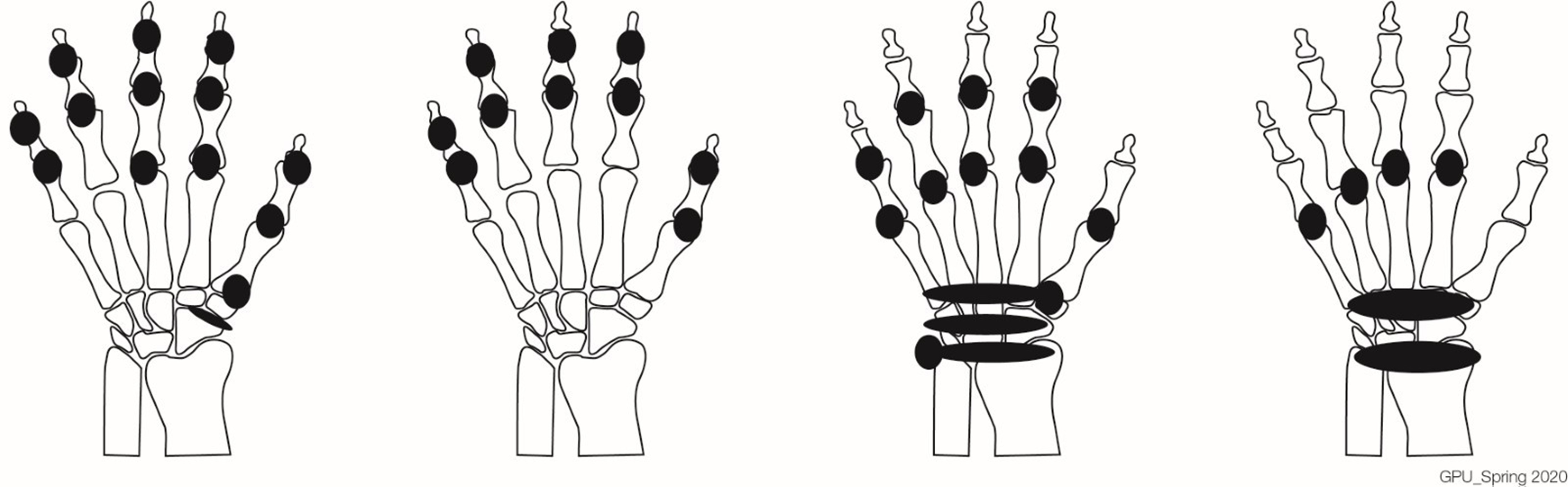 | |||
| Hand/thumb base osteoarthritis |
Erosive hand arthritis (may be OA or peripheral spondyloarthropathy) |
Rheumatoid arthritis | Haemochromatosis |
|
More gradual onset. Usually systemically well. Minor morning stiffness <1h and exacerbated by activity. Heberden’s and Bouchard’s nodes may be present. May be isolated or part of a more generalised osteoarthritis picture. |
Heberden’s and Bouchard’s nodes may be present if the cause is osteoarthritis. This pattern can also be seen in peripheral spondyloarthropathy, e.g. psoriatic arthritis. |
Systemic features. Symmetrical. Fairly rapid onset. Other joints usually affected as well. Significant morning stiffness >1h and relieved by activity. |
Systemic features often present and include:
(See separate article on Haemochromatosis). |
Investigations may be necessary if the presentation is atypical and you are considering an inflammatory arthropathy or haemochromatosis.
Treatment options
There is no perfect treatment and no disease-modifying treatment at present. There is sometimes a sense that ‘not much can be done’ for hand osteoarthritis. The EULAR guidelines remind us of our options (Annals Rheum Dis 2019;78:16).
A key message is not to forget the role of occupational hand therapy, exercises and splinting.
| EULAR (2018) recommendations for hand osteoarthritis | |
| Subtype | Recommendations |
| Hand osteoarthritis |
|
| Thumb base osteoarthritis |
|
| EULAR 2018 recommendation NOT in NICE 2022 OA guideline |
|
*Injection for base of thumb osteoarthritis
EULAR used the term “should not generally be used” in the 2018 guideline in recognition that some patients may benefit from corticosteroid injection to the 1st carpometacarpal joint. Subsequently, there was a systematic review and meta-analysis published looking at this question. 9 RCTs involving 500 patients were included in the analysis. Ultimately, the evidence was equivocal and the authors identified the need for a large, high-quality RCT to properly assess the intervention (BMJ Open 2019;9:e027507).
NICE (NICE 2022, NG226) did not specifically include or exclude any particular joint from its recommendations on corticosteroid injection, the inference being that we may consider it as an option in the appropriate patient alongside other therapies.
Prednisolone for hand osteoarthritis?
An imperfect RCT giving a 6-week course of oral prednisolone (10mg a day then tapered for 2 weeks) showed a reduction in pain, without any improvement in visible swelling or hand strength, in patients with strongly NSAID-responsive osteoarthritis of the hands affecting at least 4 small joints. The benefit disappeared very quickly after stopping the steroids (Lancet 2019;394:1993).
The authors and accompanying editorial conclude that this could be a valid therapeutic strategy for short-term relief for those with more severe pain in hand osteoarthritis.
- Given all we know about steroids, this would NOT be something the Red Whale team would consider very often in primary care; perhaps we might in exceptional circumstances, e.g. father of the bride needing to shake hundreds of hands on the big day!
OA 1st metatarsophalangeal joint (MTPJ)
This is another common site for osteoarthritis.
It is termed hallux limitus if the joint is stiff, and hallux rigidus if the joint is physiologically fused due to severe OA.
Please see our article on Forefoot pain for more details about this condition, including the role for stiff-soled shoes, corticosteroid injection and arthrodesis.
Osteoarthritis and multimorbidity
Osteoarthritis is associated with other diseases (Lancet 2019; 393:1745):
- A small increased risk of cardiovascular disease.
- A small increased risk of stroke, even after correcting for NSAID use.
- Higher disease-specific mortality for cardiovascular disease, cancer and dementia.
This association has not been fully explored, but the authors suggest it may relate to common disease pathways, e.g. inactivity, fat metabolism and the innate immune system in chronic, low-grade inflammation.
In addition, many patients with osteoarthritis have additional comorbidities.
- >50% have hypertension.
- 20% have cardiovascular disease.
- 19% have dyslipidaemia.
- 14% have diabetes.
- 12% have mental health disorders (most commonly depression).
The presence of one or more of these conditions increases the rate of progression and pain experienced.
 |
Osteoarthritis
|
 |
Reflect: do you routinely consider the pain of osteoarthritis within a biopsychosocial model? If not, try this out for 3 consultations. What impact did it have? Did it change your management? Look back on the last 10 patients you saw with arthritis: Did you order an X-ray, and, if so, why? Did it alter your management? For the next 10 people you see with walking sticks: Are they the correct height? Do they have a good ferrule on the end? |
 |
Useful resources: Websites (all resources are hyperlinked for ease of use in Red Whale Knowledge)
|
Related content
This information is for use by clinicians for individual educational purposes, and should be used only within the context of the scope of your personal practice. It should not be shared or used for commercial purposes. If you wish to use our content for group or commercial purposes, you must contact us at sales@red-whale.co.uk to discuss licensing, otherwise you may be infringing our intellectual property rights.
Although we make reasonable efforts to update and check the information in our content is accurate at the date of publication or presentation, we make no representations, warranties or guarantees, whether express or implied, that the information in our products is accurate, complete or up to date.
This content is, of necessity, of a brief and general nature, and this should not replace your own good clinical judgment or be regarded as a substitute for taking professional advice in appropriate circumstances. In particular, check drug doses, side effects and interactions with the British National Formulary. Save insofar as any such liability cannot be excluded at law, we do not accept any liability for loss of any type caused by reliance on the information in these pages.
Here is the link to our terms of use.