
 Printed on: October 19th, 2026
This Pearl is provided as free content. Here is the link to our terms of use
Agitation, restlessness and delirium at the end of life

Headlines
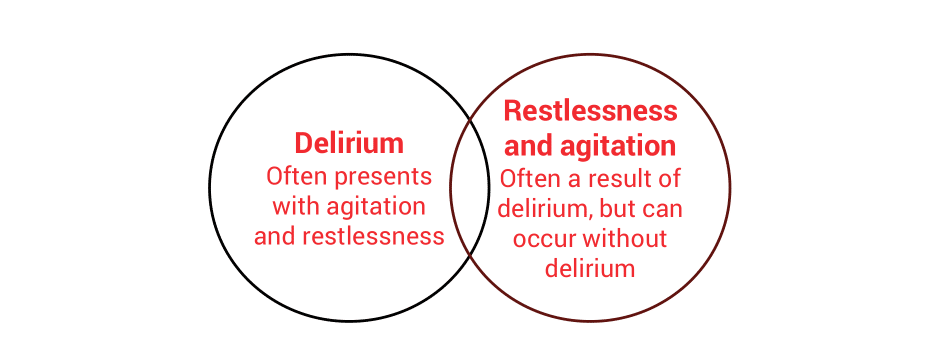
Agitation, restlessness and delirium symptoms in patients at the end of life are distressing to those around them, but are very common in the hours to days before death (Cancers 2021;13:5893). Agitation and restlessness are often seen in delirium, but can occur without it.
Delirium may be reversible, and this possibility should always be considered. In the last days of life, when an assessment has been made that reversible delirium is not present, the term ‘terminal agitation’ may be used (Scottish Palliative Care Guidelines, accessed April 2026).
This article is mainly based on a review from 2021 (Cancers 2021;13:5893). However, it is worth noting that there is not much high-quality large-scale research in this area.
This article was last updated in April 2026.
|
This article relates to agitation, restlessness and delirium at the end of life. Management will be different if the end of life is not imminent. |
Why agitation and restlessness in terminal care matter
Watching a relative who is agitated or restless is very distressing. Research shows that clear explanations to relatives, ideally beforehand, reduce relatives’ distress (BMJ 2016;353:i3085).
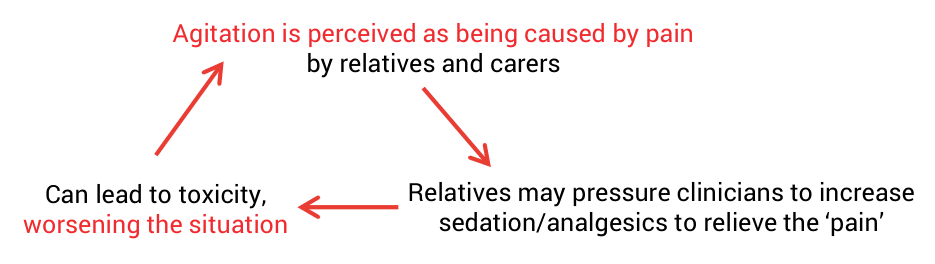
Agitation/restlessness are often perceived by relatives (and carers/staff) as being caused by pain. This leads to distress at the time, and is carried beyond death as a lasting memory. Ensuring that relatives/carers understand that the cause is NOT a sign of unbearable pain, but a symptom of delirium, is crucial (Cancers 2021;13:5893).
In addition, if relatives are not aware of this, it can lead to inappropriate escalation of treatments and worsening agitation, in what is called the ‘destructive triangle’:
A reminder from the Red Whale clinical team: normal changes around death (Cheyne–Stokes breathing, secretions) may also be interpreted as distress so make sure you explain that these are normal. For relatives, this BBC Ideas video of Kathryn Mannix, talking about normal dying, may be helpful: Dying is not as bad as you think.
Diagnosis of delirium
Please see our article Delirium and hypoactive delirium for advice on diagnosis.
Signs of terminal delirium or agitation
The Scottish Palliative Care Guidelines emphasise that signs can be intermittent and vary between individuals, but may include:
- Restlessness and/or fidgeting.
- Calling out/shouting.
- Fluctuating cognition and confusion.
- Plucking.
- Anguish, perhaps presenting as general distress.
Causes of delirium in the last days of life
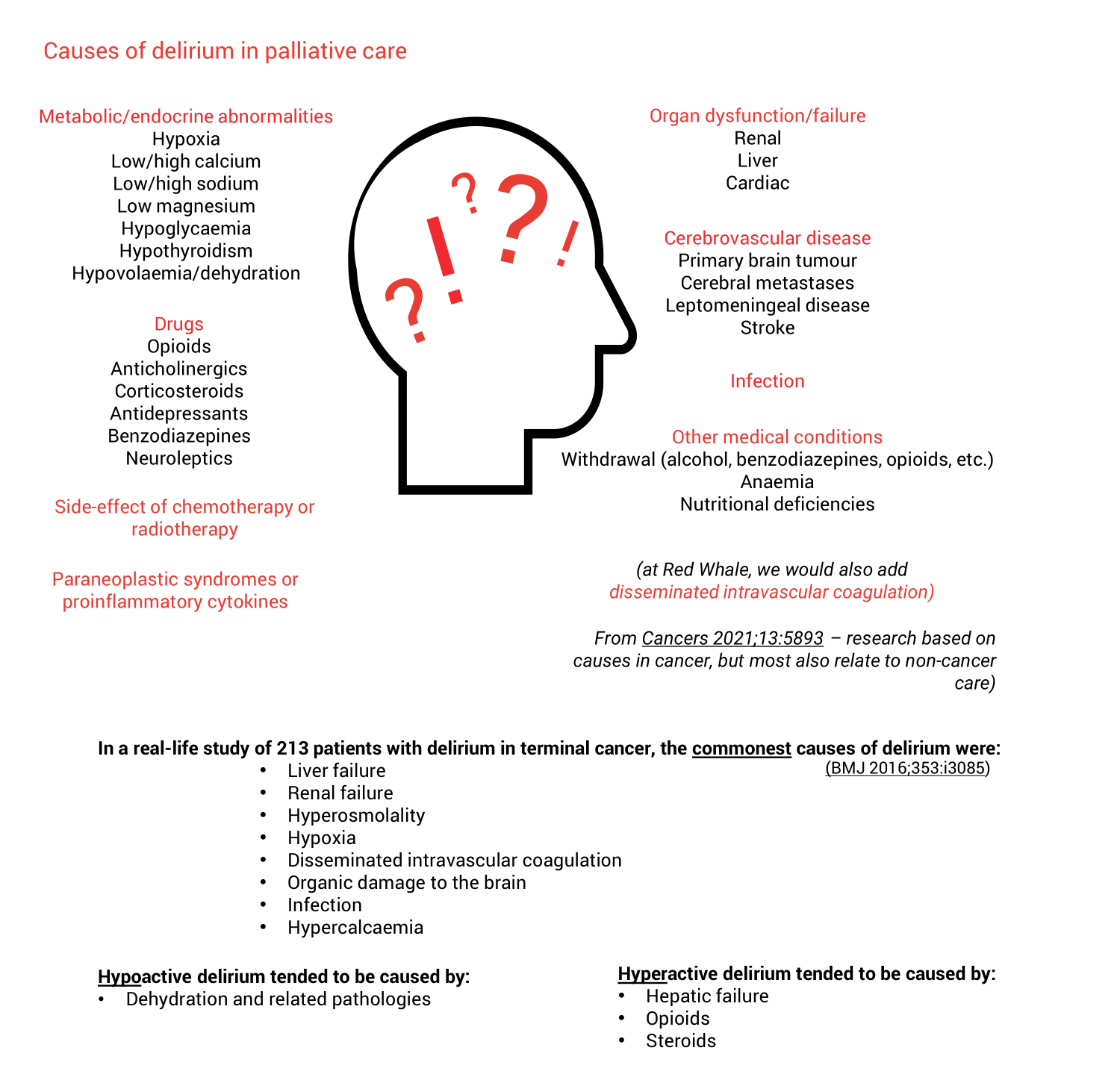
This can include all the usual causes of delirium (think of the PINCH-ME mnemonic outlined in our article Delirium and hypoactive delirium). However, there are some causes that are more likely to occur in a dying person.
And remember conditions that can cause agitation or restlessness without delirium, especially (BMJ 2016;353:i3085):
- Pain, including urinary retention or faecal impaction.
- Emotional or spiritual distress. In some people, this will include sadness and fear of dying. The Scottish Palliative Care Guidelines acknowledge the importance of spiritual or existential distress in assessing and managing symptoms. Spirituality for an individual may relate to factors impacting on their sense of identity, self-worth and meaning or purpose. This may involve connection with others or with nature, or belief in a ‘higher being’. We should regularly review whether any of these issues can be addressed to relieve agitation.
- Opioid toxicity: if this is strongly suspected, especially for uncontrolled pain, consider reducing dose by 50% and keep under close review (Scottish Palliative Care Guidelines).
Goals of delirium management in the last days of life
This article relates to agitation, restlessness and delirium at the end of life. Prognosis matters: if there is a potentially reversible cause and the end of life is not imminent, appropriate treatment may be indicated. However, when delirium occurs in the last days of life, a balance between investigating/correcting the underlying issue and a focus on managing the symptoms is needed. The burden of investigations and treatments such as IV infusions may be considered to outweigh any potential benefits.
Instead, it can be helpful to think in terms of goals (Cancers 2021;13:5893):
- Prioritising patient comfort and wishes (consider preferences for care at the time or expressed previously).
- Explanation to relatives of what is going on and (once pain is excluded as a cause) that this is NOT caused by pain, but is a common preterminal event and means the end is near.
- Optimising the safety of the patient and those around them (e.g. risk of patient trying to get out of bed and falling).
- Is it appropriate/possible to identify and correct the underlying cause(s)?
- Minimise aggravating factors (urinary retention, pain, dehydration).
- What is the best location for care (home, hospice, hospital)?
Management
Once goals have been established, this will help to decide thresholds for interventions (Cancers 2021;13:5893):
- Correct/treat reversible causes if appropriate.
- Ensure good care (especially pain relief, and ensure the family understands).
- At Red Whale, we would add: consider how the family will cope during the night/out of hours, when external support may be less available.
Non-pharmacological interventions to manage delirium
Although the evidence base here is weak, the following options may be considered:
- Control pain and other physical symptoms.
- Ensure glasses/hearing aids are worn if still appropriate.
- Encourage cognitively-stimulating activities if possible (talking to family, simple word puzzles).
- Orientate the patient (time, date, place, family photos).
- Review medications.
- Minimise catheters, IV lines and other equipment restricting freedom of movement.
- Monitor the things that might trigger or worsen any distress, and manage as appropriate:
- Bowel and bladder function (avoid retention, constipation).
- Nutrition, hydration and electrolyte balance.
- At Red Whale, we’d add: assess risk of alcohol/drug withdrawal. The Scottish Palliative Care Guidelines remind us that nicotine patches can be used if withdrawal is likely to occur.
- Good sleep hygiene and minimise noise/interruptions when sleeping.
- Maintain a calm environment, avoiding over-stimulation with loud noise and bright lighting.
Red Whale top tip: particularly in the last days of life, before considering any pharmacological interventions, attention should be paid to maintaining as calm an environment as possible. Familiar voices, sounds and smells can be soothing, while loud noise, bright lighting and over-stimulation can aggravate symptoms.
Pharmacological management of restlessness/agitation
It is important to establish whether there have been any discussions with the patient about whether they would want to be sedated at the end of life if distressed. This clearly requires sensitive discussion as part of high-quality advance care planning, and is highly dependent on context and personal beliefs/values. If this information is unavailable, any decision made must be in the best interests of the patient and be clearly communicated to those close to them. Make sure relatives understand that the purpose of treatment is to relieve distress, not to hasten death.
The West Midlands Palliative Care Guidance (accessed April 2026) suggests 3 options to manage restlessness/agitation (see table below).
For each of the drugs listed below, we recommend checking up-to-date dosing information in the BNF. In the frail or elderly, start at the lowest dose in the range. Note that:
- Patients with severe agitation may require frequent dosing initially (30–60min intervals) until settled.
- For patients needing rapidly escalating doses, contact the palliative care team for advice.
- Combined treatment with antipsychotic and benzodiazepine may sometimes be required.
| Drug | Indications in restlessness/agitation |
|
Midazolam
|
|
|
Haloperidol
|
|
|
Levomepromazine
|
|
QT interval and end-of-life medications
Many of the drugs used in palliative and supportive care symptom control carry a risk of QT prolongation. In the last days of life, prescribers should be aware of this risk and should avoid it where possible by avoiding unnecessary polypharmacy. Where it is not possible to totally avoid the risk, it is usually appropriate to prioritise comfort and relief of distress. In this situation, ECG monitoring would not be required.
 |
Agitation, restlessness and delirium at the end of life
|
This information is for use by clinicians for individual educational purposes, and should be used only within the context of the scope of your personal practice. It should not be shared or used for commercial purposes. If you wish to use our content for group or commercial purposes, you must contact us at sales@red-whale.co.uk to discuss licensing, otherwise you may be infringing our intellectual property rights.
Although we make reasonable efforts to update and check the information in our content is accurate at the date of publication or presentation, we make no representations, warranties or guarantees, whether express or implied, that the information in our products is accurate, complete or up to date.
This content is, of necessity, of a brief and general nature, and this should not replace your own good clinical judgment or be regarded as a substitute for taking professional advice in appropriate circumstances. In particular, check drug doses, side effects and interactions with the British National Formulary. Save insofar as any such liability cannot be excluded at law, we do not accept any liability for loss of any type caused by reliance on the information in these pages.
Here is the link to our terms of use.