
 Printed on: September 23rd, 2026
This Pearl is provided as free content. Here is the link to our terms of use
Communicating our needs and setting boundaries?
“I am who I am today because of the choices I made yesterday.” – Eleanor Roosevelt
Making lifestyle change often involves creating new habits or changing existing habits, and this can take time, effort and mental energy. Life does not pause, and it may be difficult to make or maintain change alongside our ongoing commitments and responsibilities at work, home and in our social lives. We need skills to negotiate these barriers and blockers to making lifestyle changes, including:
- Recognising our needs and thinking flexibly about how to balance our different priorities.
- Being able to communicate our needs and create boundaries that ensure important changes can happen.
- Recognising that our own needs for self-care are just as important as the needs of other people in our lives (whether at home, work or socially). Some people call this assertiveness – we prefer to use the framework of nonviolent communication.
- Being willing to sometimes say no – because whenever we say yes to one thing, we are saying no to something else.
This is not an evidence-based article, as such; rather a collection of tools that may be useful in our own lives as well as to support patients who seek our help.
We hope that this article empowers you. It was written in April 2024.
A note about boundaries
“You just need to create some boundaries.”
Is this true? Maybe … but we also need some flexibility.
What is a boundary?
In her book ‘Dare to Lead’, Brène Brown explains boundaries simply as:
“What is ok and what is not ok.”
The American Psychological Association has a more complex definition:
“A boundary is a psychological demarcation that protects the integrity of an individual or group or helps the person or group to set realistic limits on participation in a relationship or activity.”
Boundaries help us to preserve what is of value to us in our personal and professional lives. It is not unusual for health professionals to feel ‘guilt’ about putting boundaries in place because of the nature of the work we do. However, a feeling of guilt may simply be a sign of being a caring professional with high standards and expectations. It is not necessarily a sign that we have done something ‘wrong’.
Why might healthcare professionals find boundaries difficult?
An interesting Perspectives piece looked at boundary setting in hospital clinicians, and identified a number of challenges. Many of these are also applicable to clinicians working in primary care (Journal of Hospital Medicine 2023;18(12):1139):
Career stage
- In early career stages, the importance of building connections and seeking new opportunities to learn and advance career prospects can make it easier to say yes than no. There is also a power imbalance – it can be hard to say no when you perceive that a reference or future career opportunities may be at stake.
- In later career stages, we may have reached positions of expertise or leadership, and be asked to do more things, e.g. reviewing papers, speaking at conferences, teaching – most of us will have many examples of how this work is often unfunded, both in time and money. We may also have developed entrenched behaviours of saying yes, which can make it difficult to behave differently, e.g. we may be perceived as a person who ‘gets things done’ – this can cause some consternation if we start to put boundaries in place.
Characteristics of clinicians
This article acknowledges that many clinicians have the desire to please others (all humans do – it is an evolutionary adaptation!), and also to be empathic and good team players.
These are great qualities. But in a failing health system where it is not possible to meet all the demands put on us, there is evidence that those individuals least able to put boundaries in place are more likely to experience burnout. In fact, the research goes further. In a Netherlands-based study (Front Psychol. 2020;11:607294):
- Those with blurred work–life boundaries, such as working from home with frequent transitions between work and family roles, were less able to sustain healthy lifestyle behaviours, were at greater risk of emotional exhaustion and were less happy.
- Those with healthier lifestyle patterns were somewhat protected from the challenges and ill-effects of compromised work–life boundaries. Having sufficient sleep and being physically active were found to be particularly important.
While this applies to clinicians, it probably also applies to many patients we see!
Let’s stop for a minute and consider why we may be putting boundaries in place, and how they relate to our needs.
Identifying what we need
Many of us will be familiar with Maslow’s hierarchy of needs (Psychological Review 1943, 50(4),370-96).
The premise of this older theory is that humans share common needs, the most fundamental of which are located at the bottom of the pyramid. If the needs on the lower layers are not fulfilled, the needs on the higher layers, which are increasingly psychological and aspirational, cannot be achieved.
Here is an illustration:
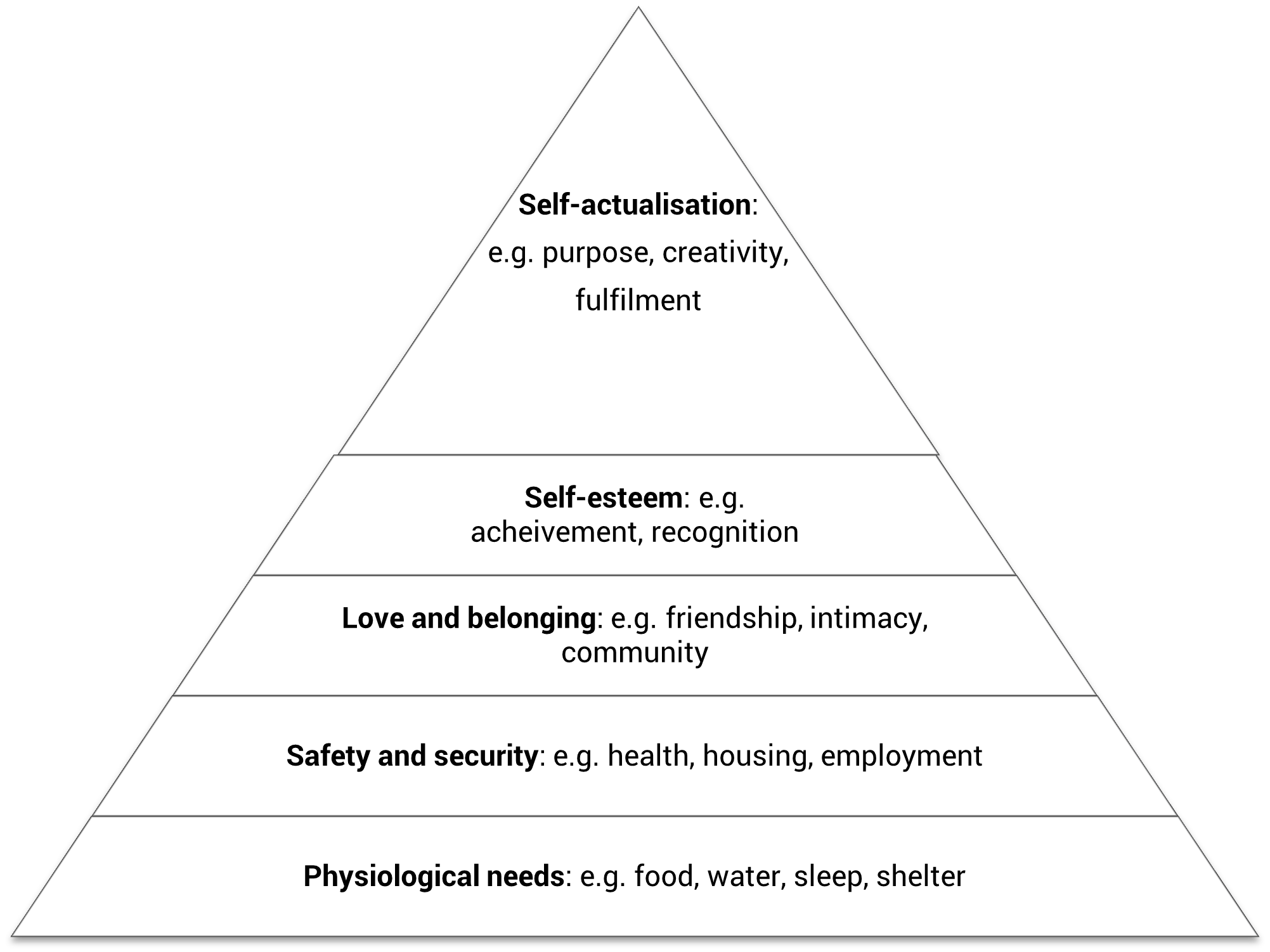
This highlights that some basic needs many of us push to one side in busy modern life could be seen as non-negotiable in order to stay healthy and well.
If these needs are not met on a regular basis, it’s impossible to remain effective in any part of life. For example, it’s never really OK to go for a prolonged period without having time to get a drink of water, go to the loo, or take a 10-minute movement or thinking break! Equally, we should think carefully about compromising our sleep by catching up on work late at night.
As we move up the hierarchy, there may be more flexibility and compromise about how to balance and prioritise different needs.
A more holistic view of needs
Needs are also described in literature on nonviolent communication (Marshall Rosenberg 2015, Nonviolent Communication: a language of life). Here, needs are not ranked into a hierarchy, but are seen as being universal to every human; they will therefore affect all of us in different ways, in every part of our lives.
Recognising our needs involves noticing the immediate urges or impulses that arise in a particular situation, and which may influence our actions or choices. This can help us to understand and make sense of what may be getting in the way of setting boundaries, being more assertive or in making change in our lives.
There are many important human needs, including:
- Basic physical needs: food, water, shelter, air, sleep, rest, health, movement.
- Acceptance: empathy, love, respect, support, approval.
- Acknowledgement: to matter, to be valued, to be appreciated, to be heard, to be seen, to mourn.
- Autonomy: choice, independence, freedom, power, responsibility, space, being empowered, consent.
- Belonging: communication, community, cooperation, inclusion, participation, sharing.
- Connection: affection, appreciation, closeness, warmth, care, partnership.
- Enjoyment: fun, play, laughter, excitement, celebration, humour.
- Inspiration: beauty, faith, hope, peace, presence.
- Meaning and purpose: contribution, effectiveness, fulfilment, achievement, using skills, creativity.
- Safety and security: financial and physical safety, predictability, dependability.
- Sense of self: authenticity, integrity, self-acceptance, self-compassion, dignity.
- Trust: honesty, equality, fairness, certainty, loyalty.
- Understanding: awareness, clarity, learning, discovery, growth, stimulation, exploration.
Which of these resonate with you?
Finding ways to meet our needs
Having a clear understanding of our needs allows us start to take responsibility for meeting them in a more consistent and healthy way. We can also develop greater compassion for ourselves in the times that our needs are not fully met.
We can choose multiple different strategies to meet a particular need. To make changes easier to carry out and to help with building healthy habits, it is important to ensure that our strategies are small and realistic – involving ‘micro-steps’ that only take a few minutes to complete.
For example, we could meet a need for connection by seeing friends, playing with a family pet, connecting via social media or joining a local walking group.
It’s important to keep these strategies flexible and adapt them to changing circumstances.
Needs that support lifestyle change
Needs that may be important for supporting lifestyle change include:
- Having autonomy and choice.
- Finding meaning or purpose in the change.
- Feeling that we matter (to ourselves and to those around us).
- Treating ourselves with kindness and compassion (rather than with criticism and self-judgement).
- Seeking connection with others to support changes in behaviour.
A note for health professionals
Needs also matter to us as health professionals. If we are not making time to meet important needs, such as getting enough rest, regular meals, or time to relax, it’s difficult to remain professionally and personally effective. The emotional toll of letting our energy tanks run dry, and running on empty, is huge.
The goal is to keep a balance between different needs, without allowing any to dominate. For example, if we constantly prioritise the need for acceptance and approval by others, while ignoring the need to refuel, to stay active, or to acknowledge that our feelings matter alongside other people’s, it becomes harder to set effective boundaries, and we are at risk of becoming overwhelmed, stressed or burned out.
What gets in the way of meeting our needs?
It’s not always easy to meet our needs fully. Multiple needs may arise at the same time, or external factors such as time constraints, limited resources or competing priorities/interests can get in the way. We may have a need for relaxation, social connection or physical movement, but our work demands mean that it is hard to find time to meet these needs effectively.
Feelings of guilt or being a ‘chronic hero’ can also make it harder for us to prioritise our own needs. If we are feeling burned out, low or emotionally exhausted, we may lack the inner resources to recognise and assert our needs with others.
Self-awareness is key. If we recognise our feelings and their impact on our behaviour, we can take steps to improve our wellbeing and make better choices. It may be helpful to really prioritise the need for self-care, and take active steps to ensure that we are refuelling regularly so that our emotional energy tank is less close to running on empty.
Needs vs. strategies
Understanding the distinction between needs and the strategies to meet those needs is crucial in navigating complex situations. It’s rarely needs that are in conflict, but rather the methods or strategies used to try and fulfil these needs.
For example:
- A manager may wish to maintain productivity and efficiency (NEED) by enforcing long working hours (STRATEGY).
- An employee may seek work–life balance (NEED) and prefers flexible hours (STRATEGY) to maintain wellbeing.
The conflict is not between the needs, but in the strategies.
If we can identify and discuss the underlying needs, we can then have greater flexibility in the choices and actions that we take, looking for creative solutions that meet everyone’s needs as much as possible. We talk more below about how to have assertive conversations that express our needs.
A reflective exercise: what are your needs and how might you meet them?
You might find this activity useful. We have given you an example for the first line.
| Area of the 6 pillars | What’s the relevant need? | What other needs might act as ‘blockers’ or get in the way? | What small step could you plan to meet this need in a realistic way? | Red flags/non-negotiables – how would you notice you aren’t meeting your needs? |
| Physical activity | Being active makes me feel calmer and less stressed, and it’s also important for my health. I know I’m at risk of type 2 diabetes like my dad. | I care about my team and I want to be seen as pulling my weight at work. I also have a busy family life. This makes it hard to find time to get to the gym! | I could plan to go for a walk before work at least 2–3 times a week, and also make sure I get out and stretch my legs at lunchtime. | If I miss walking for a few days, I find myself getting anxious and irritable, and my knee also starts getting more stiff and painful. |
| Nutrition | ||||
| Sleep | ||||
| Minimising harmful substances | ||||
| Stress management | ||||
| Social relationships |
Having identified why we need to consider our needs and set boundaries, what skills might we need to communicate and enforce them?
Communicating our needs
When trying to make changes in our lives, we may need to communicate our needs clearly to others and find ways to negotiate the space, time or resources to meet them.
Some people refer to this as assertive communication. Assertiveness is a communication skill to add to our toolbox. Like all skills, it is one that we can practise to strengthen our ‘assertiveness muscles’.
One way to define it is as an ability to communicate in a manner that respects our own rights, needs, opinions and values, while acknowledging and respecting those same things in others.
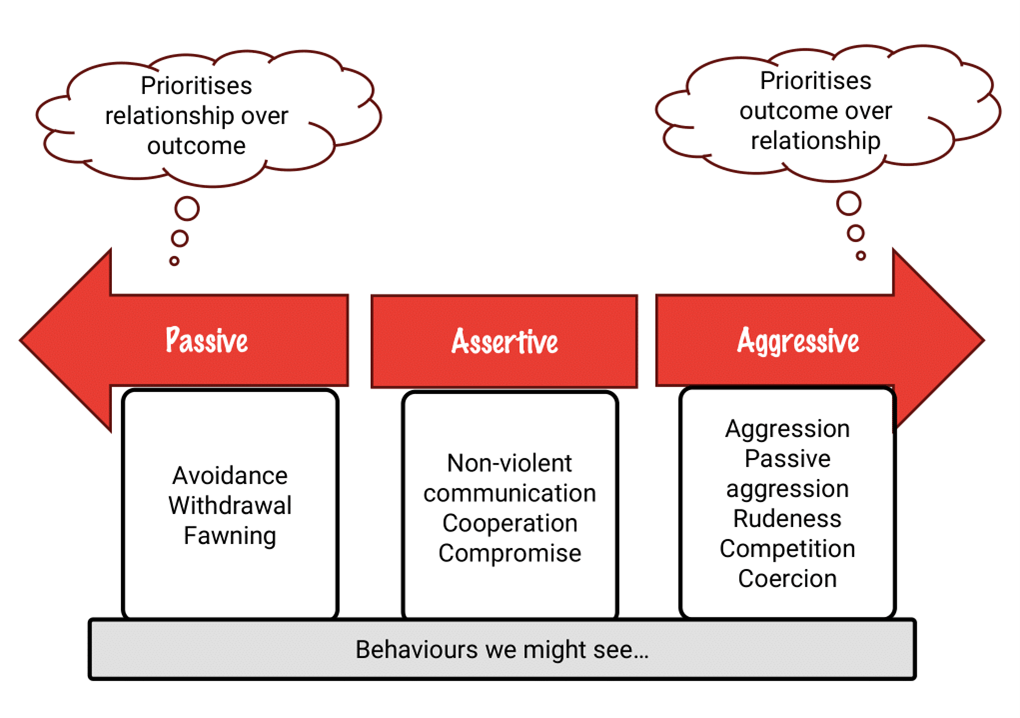
You may have heard of nonviolent communication – this is a specific type of assertive communication and may be most comfortable to many of us as clinicians. We’ll talk more about this as we go through the article.
Let’s have a look at some practicalities…
Approaching conversations in the right frame of mind: do you need to create a pause?
| Before starting your conversation | Strategies to consider |
|
Observe how you are feeling: Often, these conversations come in the context of ‘conflict’, e.g. where we feel a boundary has been overstepped, or where we disagree with a colleague, patient, client or family member.
This is not a great state in which to start a difficult conversation!
|
If you are feeling triggered: Try to create some time and space, and step out of the threat response before you begin a difficult conversation. This might involve:
If you have not had a strong emotional response:
|
|
How are we approaching the conversation? Our internal dialogue is powerful. Our minds will generate stories about ourselves or other people involved in the situation. This will be influenced by negative or positive past experiences. Nonviolent communication suggests a non-judgmental, blame-free approach to challenging conversations. This is another reason why creating space before responding is useful - it enables us to process the very normal human emotions and judgement that the conversation raises in the privacy of our own minds. It is easy to assume we know what the other person is thinking in this situation. But this can only ever be a guess, and can lead us down a path of unhelpful thoughts, e.g. If I say no to doing that extra clinic, they will think I am lazy/a bad doctor/that I don’t pull my weight. Our minds may also tell us these things about ourselves.
|
Use wise mind: To approach the conversation in a helpful way, we can use our ‘wise mind’. This might involve seeking the wider perspective, and being flexible, supportive, encouraging, friendly and fair to ourselves and others. We could try out these things:
|
Preparing what you want to say
Conversations about creating the space we need for self-care are often negotiations that may need some preparation.
Planning what to say using a framework can be helpful. There are many frameworks, but we like the nonviolent communication framework (Marshall Rosenberg 2015, Nonviolent Communication: a language of life). It focuses on identifying each individual’s emotions and needs, before trying to decide how to resolve the situation. This helps to build connection and relationships, and creates more space to be creative and brainstorm different ways of dealing with things, rather than getting stuck insisting that there is only one way to solve a complex problem.
We have adapted the model slightly to create a helpful way to remember the four steps: DEAR (Lee David and Debbie Brewin, 2023, Scion Publishing). DOI: Lee David is a Red Whale presenter and author).
- Describe the situation without judgments or blame.
- Emotions: recognise and express how you are feeling.
- Ask what matters: what needs may be important to you and to the other person?
- Reasonable Request: what can you ask for that might help meet your needs?
| Assertiveness step | What are you trying to do? | What could you say? | What NOT to say! |
| Describe the situation |
Imagine you are a neutral observer of the situation. What did you see or hear? Can you express yourself honestly while avoiding judgements or blame? |
The situation seems to be that… I noticed that… I heard you say that… I can see that something is not working as it should… |
Judgements: You should… Blaming: This is because you… Advising or explaining: The problem is that you should… Making demands: You must… I need you to… Criticism: You’re such an idiot… |
| Emotions |
Notice your feelings and emotions. You may express these aloud to the other person, or simply acknowledge them to yourself: How do I feel about this? What emotions can I notice? What’s behind my reaction? |
Feelings experienced when our needs are being met include: relaxed, safe, inspired, excited, content, satisfied, proud, affectionate. Feelings experienced when our needs are NOT being met include: irritable, frustrated, anxious, shocked, confused, tired, bored, sad, hurt. |
Avoid giving others responsibility for your feelings: You are making me feel… |
| Ask what matters | What values and needs are important to you in this situation? How about the other person? What might their needs be? How are these different or similar to yours? | What matters to me is being able to support each other, having an effective team, making sure everyone is heard, for fairness in the distribution of tasks… | Remember not to jump ahead to solving the problem or discussing strategies at this stage: What we should do is… |
| Reasonable Request | This involves asking yourself or another person to take a specific action. Choose an action that is likely to meet the needs identified in the previous step. Be as creative as you can and try to think of several possible solutions. How can you ask in a way that’s respectful and likely to be received well? |
Can you tell me what you have heard me say today? Could you give me a little while to think about your request? Could you help me understand why you made that decision? Can you tell me how you feel about what happened? |
Only ask for things the person has the power to carry out. Ensure it is a request and not a demand; the other person must be free to say no without any negative consequences. |
Here’s an example of the model in action:
| Describe the situation | I’ve noticed that I’m spending a lot of time on household tasks and taking the kids to their activities. As a consequence, I missed going to my weekly choir twice in the past month. |
| Emotions | I feel frustrated and sad. |
| Ask yourself what matters | I care about our home and I like it to feel clean and tidy. It’s also important to me that the kids are able to do sports and activities that they enjoy. Alongside this, going to choir is really important for my happiness and wellbeing – I love it! I also value our relationship, and would like us to work together and share the important responsibilities at home. |
| Reasonable Request | Can we talk about what we can do as a family to make sure I can leave on time and make it to choir every week? I’d also like to talk about all the different jobs and responsibilities, and find a way forward that is fair and supportive for us both. |
Saying no
Could you coach the under-7s football team this year? Go on, you’d be great!
Could you set up a Facebook group for the practice? You’re really good on social media!
Can you take the lead on this new prescribing initiative…?
Of course, the answers to any of these might be yes – they might be in line with our needs and values. But, sometimes, we may want to simply say no.
And while it is said that ‘No is a complete sentence’, and you don’t have to offer an explanation, for many of us, this feels really uncomfortable.
If this is you, you are not alone – in fact, it is quite normal. Humans are hardwired to be so-called ‘people pleasers’. We have evolved to live in socially-connected groups, and the consequences of displeasing our tribe historically could have been exclusion, starvation and being gored by a woolly mammoth! It therefore isn’t surprising that the thought of ‘upsetting’ people or making them ‘cross’ strikes horror into many of us. This is a hardwired threat response that stems from our instinctive understanding of the importance of social connection for safety and survival.
If you do want to say no, here are some tips…
- Create a pause, as discussed above. This will provide some thinking time to consider which needs are involved in the situation, and how to balance different priorities, such as wanting to maintain your relationship with the person while setting boundaries around your commitments.
- If you want to say no, try to keep it direct. If you feel you need to offer an explanation, keep it short.
- If you want to ‘soften’ a no, or are concerned it may be too confrontational, options include:
- Not now…
- Not unless…
- Not that, but this…
It can be useful to have some language to draw on in specific situations where we might want/need to say no:
| The situation | What might you say? |
|
I don’t have time (it isn’t aligned with my values now) For example, you have a full diary with a portfolio career, working 3 days at a GP practice and 2 days at home with your children who have not yet started school. The current schedule offers time with your family, and the opportunity to include some physical activity and connection with friends in your week. You have always enjoyed medical education, and are offered the opportunity of a regular teaching slot at the local university. This is something you would consider in the future, but not at the moment. |
Thank you for thinking of me. I don’t have time to take this on at present, but if a similar opportunity came up in 2 years time when my children have started school, I would love to consider it again. |
|
I don’t have the emotional bandwidth (I can’t give this the energy it needs) For example, alongside a busy job, you have been attending a local community neighbourhood group for the past year. The meetings often run late into the evening, and you are often tired and find it hard to sleep afterwards. At the latest meeting, it is agreed that the group will organise a local fundraising event that requires considerable planning. Your neighbour suggests that you take the lead because you have experience and knowledge in event planning. |
I can see that you are seeking someone to organise this important event, and I greatly appreciate your trust and belief in my ability to help. Unfortunately, at the moment, I am balancing many different pressures and responsibilities, and I do not have sufficient time to commit to taking on this project with the level of focus and energy that it deserves. I will therefore have to decline on this occasion because I need to prioritise my existing time commitments. |
|
I don’t have the skills/knowledge to support with this For example, you are an ANP helping with the triage list. Next on the list is a 6-month-old baby. You are currently only trained to see children aged over a year. You go to the practice manager who says that the duty doctor is busy with an emergency and can you ‘just check’ on the baby. Should you see them? |
I can see how busy everyone is and I really care about the welfare of this child. However, I’m not trained or indemnified to see any children aged under a year. I’m very committed to the practice, and I want to work hard and support others in our team, but only in ways that are safe and within my professional competence. I’m not going to be able to make any decisions or assessment of this baby. I’ll look at the list and see what other patients I can see… |
How will others react if I say no?
If we use the principles of nonviolent communication when communicating a ‘no’, it is more likely to lead to a flexible conversation in which everyone leaves feeling they have been treated respectfully.
However, we cannot determine how others will respond when we say no. This will depend on their expectations and perception of the situation. They may feel disappointed, inconvenienced, frustrated or even hurt by a refusal, particularly if you are someone who usually says yes to requests, or if they were counting on your support or involvement. They may struggle to understand your reasons for saying no, or perceive it as a personal rejection.
Some tips for coping with other people’s reactions when we say no include:
- Express empathy and understanding for their feelings, while standing firm in your decision. You may wish to explain your reasons (this is not always necessary), but without sounding defensive or apologetic. Remind them that you value their relationship and that their feelings are important to you.
- If someone is persistently asking for what they want even after you have said no, it is important to maintain your boundaries and calmly repeat your decision. Be polite but firm, and avoid getting into a debate or argument. You do not have to defend your position or convince others to agree with your perspective.
- Try not to allow feelings of guilt to make you doubt yourself. Remember, it is OK to prioritise your own needs and values, and to hold important boundaries.
- Practise self-care. Saying no can be emotionally demanding, especially if you are concerned about upsetting or disappointing others. Do activities that help you relax and recharge. This can help you cope with any difficult emotions that arise from the situation.
- Seek support. It is often helpful to reach out to colleagues, friends or family, who may be able to offer a fresh perspective and emotional support with facing challenging situations.
 |
Communicating our needs and setting boundaries
|
 |
Try out some of these tools in simple, low-stakes situations. Spend some time reflecting on your own needs and some strategies you could use to meet them. |
 |
Useful resources: Podcasts (all resources are hyperlinked for ease of use in Red Whale Knowledge) Rachel Morris covers some of this content brilliantly in her Podcast ‘You are not a Frog’. You can listen here or on your usual Podcast provider: |
This information is for use by clinicians for individual educational purposes, and should be used only within the context of the scope of your personal practice. It should not be shared or used for commercial purposes. If you wish to use our content for group or commercial purposes, you must contact us at sales@red-whale.co.uk to discuss licensing, otherwise you may be infringing our intellectual property rights.
Although we make reasonable efforts to update and check the information in our content is accurate at the date of publication or presentation, we make no representations, warranties or guarantees, whether express or implied, that the information in our products is accurate, complete or up to date.
This content is, of necessity, of a brief and general nature, and this should not replace your own good clinical judgment or be regarded as a substitute for taking professional advice in appropriate circumstances. In particular, check drug doses, side effects and interactions with the British National Formulary. Save insofar as any such liability cannot be excluded at law, we do not accept any liability for loss of any type caused by reliance on the information in these pages.
Here is the link to our terms of use.