 Printed on: November 26th, 2026
Disclaimer
Please note, once printed or downloaded, articles cannot be updated. By bookmarking the article and continuing to access it online, you can be sure you are reading the most up-to-date information and that you are not in breach of copyright laws.
This Pearl is provided as free content. Here is the link to our terms of use
Shingles (herpes zoster)
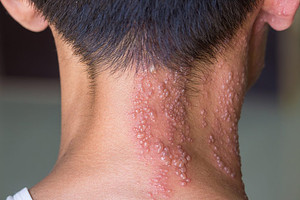
‘’Doc, I have this odd burning feeling across my side but there is nothing to see. I also feel a bit unwell, nothing in particular, just tired, achy and a bit low…’’ She was right – there was nothing to see on her skin. We talked about the possibility of shingles and, sure enough, 2 days later she was back with a florid shingles rash.
The information in this article comes from two BMJ reviews: a Best Practice article on herpes zoster infection and a 10-Minute Consultation on herpes zoster ophthalmicus (BMJ 2019;364:k5095, BMJ 2019;364:k5234). We also include information from the Green Book where relevant (Green Book, chapter 34, Varicella, accessed October 2025).
This article was updated in January 2026.
Headlines
- Shingles (herpes zoster) is more common in older people, but can occur at any age:
- <2 cases/1000/y in the under-50s.
- 11 cases/1000/y in those >80y.
- Shingles is the reactivation of the varicella zoster (chickenpox) virus which has been dormant in the dorsal root/cranial nerve ganglia.
- When shingles affects the ophthalmic division of the trigeminal nerve, it is called ‘herpes zoster ophthalmicus’ or ‘ophthalmic shingles’.
- Same-day referral to secondary care is needed for:
- Anyone with herpes zoster ophthalmicus.
- Anyone with shingles (adult or child) who is immunocompromised.
- The most common complication of shingles is post-herpetic neuralgia; this is more common in older people.
- Antivirals, ideally within 72h of rash, are recommended for some higher-risk individuals.
- There is a well-established vaccination programme in the UK for older adults and severely immunosuppressed people. The vaccine changed from Zostavax to Shingrix in September 2023.
Before we look at this in more detail, a practical point…
Where should patients wait to be seen?
The following patients with suspected shingles should wait in a side room to decrease the risk of exposure to others:
- Patients with suspected shingles with a rash in exposed areas.
- Immunocompromised individuals with a rash anywhere on the body (as immunocompromised people can shed virus from the respiratory tract as well as from vesicles).
In these groups, a ‘significant’ varicella contact is a face-to-face conversation or being in the same room for 15 minutes or more, and we suspect many of our patients wait longer than 15 minutes to see us! (gov.uk - guidelines on post-exposure prophylaxis (PEP) for varicella or shingles (July 2025))
This may only be a small number of our patients with shingles – so how do we make this isolation happen in practice? Is it simpler to say that all possible shingles cases are to wait in a side room?
Shingles presentation
Diagnosis is almost always clinical. Consider further tests if:
- Unsure if HZV or HSV: swab and send for PCR.
- Neuropathic pain but no rash (zoster sine herpete): send blood for PCR.
| All cases (BMJ 2019;364:k5095) | Specific considerations for herpes zoster ophthalmicus (BMJ 2019;364:k5234) |
|
|
Complications
Remember: we will be referring anyone with herpes zoster ophthalmicus for a same-day secondary care assessment.
| All cases | Specific considerations for herpes zoster ophthalmicus |
|
|
Immunosuppression and shingles
If a patient is immunosuppressed and they develop shingles, they are at higher risk of disseminated zoster and death; they require same-day referral to secondary care (BMJ 2019;364:k5095). Immunosuppressed individuals also shed more virus, increasing the risk of transmission to others – see Chickenpox (including post-exposure prophylaxis in high-risk groups).
Who counts as immunosuppressed?
This includes people with (Green Book, chapter 34, Varicella, accessed October 2023 and UKHSA Guidelines 2023):
- HIV (incidence of shingles 15x greater than in the general population).
- Lymphoproliferative malignancies.
- Severe primary immunodeficiency.
- Chemotherapy or radiotherapy for cancer, and for 6m after completion.
- Previous solid-organ transplant and on immunosuppressive treatment.
- Bone marrow transplant, and for 12m after finishing immunosuppressive treatment (longer if graft-versus-host disease).
- Corticosteroids (note that the Green Book and UKHSA vary slightly here, but this captures all scenarios):
- High-dose corticosteroids (equivalent to adults ≥40mg prednisolone per day; children 2mg/kg/day) for more than 1 week in the past 4 weeks.
- Moderate-dose corticosteroids (equivalent to adults ≥20mg prednisolone per day; children 1mg/kg/day) for more than 10 days in the previous month.
- Long-term moderate-dose corticosteroids (equivalent to ≥10mg prednisolone per day; children 0.5mg/kg/day) for more than 4 weeks in the previous 3 months.
- Other immunosuppressive drugs: azathioprine, ciclosporin, methotrexate, cyclophosphamide, leflunomide and newer cytokine inhibitors.
If an immunosuppressed person, as defined above, is exposed to shingles, they may need post-exposure prophylaxis with oral antivirals. This depends on whether the contact was significant and in the infectious period, and whether the person is susceptible. See the UKHSA guidance and our article Chickenpox (including post-exposure prophylaxis in high-risk groups) for more details.
Management of shingles (all types except herpes zoster ophthalmicus)
The goals of treatment are:
- To reduce symptoms.
- To use antiviral treatment in higher-risk people to:
- Reduce viral replication and stop new lesions coming.
- Prevent/reduce the risk of complications.
|
General advice |
|
|
Antivirals
|
Who needs them? Offer oral antivirals within 72h of onset of rash to individuals who have any of the following:
Note that patients with immunocompromise or herpes zoster ophthalmicus are managed differently, including same-day referral to secondary care (see other parts of the article). Consider antivirals:
For immunocompetent children with shingles, oral antivirals are rarely recommended. Which antiviral? Famciclovir, valaciclovir and aciclovir are all equally effective. Duration?
Antiviral use in pregnancy Antivirals are not licensed for use in pregnancy.
Other formulations
|
| Symptom relief and analgesia |
Options include (BMJ 2019;364:k5095):
|
| Vitamin D? | UK biobank data showed no association between shingles and vitamin D levels, or use of vitamin D supplementation. There is no evidence that vitamin D can treat or prevent shingles (BJGP 2022;72 (724):e842). |
| Steroids |
These would be given for symptomatic management, NOT to reduce/prevent post-herpetic neuralgia (see below).
|
Management of herpes zoster ophthalmicus
Refer ALL to ophthalmology/eye casualty urgently, to be seen that day. They will guide management and follow-up, but we should not delay starting antivirals while the person is waiting to be seen (BMJ 2019;364:k5234).
| Antivirals |
|
| Lubricating eye ointment |
Required if impaired blinking reflex:
|
| Antibiotics | If superimposed bacterial infection suspected, treat with oral antibiotics. |
Do not prescribe:
- Topical aciclovir.
- Antibiotic drops.
- Topical anaesthetic drops (prevent corneal healing and may worsen corneal denervation).
Ophthalmology may suggest analgesia, topical corticosteroids (for stromal keratitis/uveitis) or antibiotic ophthalmic ointment to protect ocular surface (be guided by secondary care).
Managing post-herpetic neuralgia
This is the most common complication of shingles. It is neuropathic pain persisting after the rash has healed (BMJ 2019;364:k5095).
- Affects 5–32% of patients who have had shingles; risk increases with age.
- Usually resolves within 6m; risk of persistent pain increases with age.
- Can be miserable and debilitating.
Management
Management is stepwise, with simple analgesia then neuropathic agents (NICE says we can offer a choice of amitriptyline, duloxetine, gabapentin or pregabalin, NICE CG173 2013 (updated 2020)), and topical capsaicin is also an option – see the article on Neuropathic pain for more details.
HIV testing in people with shingles
Joint HIV guidelines (BASHH HIV testing guidelines 2020) recommend an HIV test for those with shingles. Shingles is an ‘indicator condition’ for HIV, with an undiagnosed HIV prevalence of at least 1/1000. See our article HIV: testing in primary care for more details.
Referral
The BMJ review states that same-day referral to secondary care is needed for (BMJ 2019;364:k5095):
- Anyone with herpes zoster ophthalmicus.
- Anyone with shingles (adult or child) who is immunocompromised.
We think most clinicians in primary care would err on the side of caution, and, at a minimum, discuss all cases of shingles in people with any degree of immunocompromise.
In addition, we should consider referral/specialist advice for:
- People thought to be immunocompetent who have had two or more episodes of shingles.
- New vesicles still forming 7 days after oral antiviral treatment.
- Recurrent shingles in an immunocompromised person (they may be offered long-term prophylaxis).
- Severe pain if we are considering strong opiates, e.g. morphine.
What about people who are concerned that they have been exposed to shingles?
Can you catch shingles?
No! You cannot catch shingles from someone with shingles.
But, if someone has not had chickenpox, they may get chickenpox following a shingles contact (exposure to the varicella zoster virus).
Exposure to shingles can require post-exposure prophylaxis in some high-risk individuals, including pregnant women, immunosuppressed individuals and some neonates.
Shingles contact in pregnancy
See article Rashes and exposure to rashes in pregnancy.
Shingles contact in immunosuppressed individuals and neonates
See our article Chickenpox (including post-exposure prophylaxis in high-risk groups) and UKHSA 2023 (updated 2024, 2025) guidance on post-exposure prophylaxis for chickenpox and shingles.
Shingles vaccination programme
The incidence of both shingles and post-herpetic neuralgia has decreased since the introduction of the shingles vaccination programme.
In September 2023, Shingrix replaced Zostavax in the UK immunisation programme (Green Book, accessed October 2025).
Eligible adults are:
- Those aged 60–79y.
- Severely immunosuppressed individuals aged 18y and over (with no upper age limit).
Where an individual has turned 80 years of age following their first dose of Shingrix, a second dose should be provided before the individual’s 81st birthday to complete the course. We have included full details of the vaccination programme, and the vaccine, in our associated article: Vaccinations in primary care.
 |
Shingles
|
 |
There is an increased risk of shingles with long-term corticosteroid use and in patients on moderate to high-dose steroids. People taking them need consideration of post-exposure prophylaxis if they have had a significant shingles contact:
Read more about post-exposure prophylaxis in the UKHSA guidelines. |
 |
Useful resources: Websites (all resources are hyperlinked for ease of use in Red Whale Knowledge) |
This information is for use by clinicians for individual educational purposes, and should be used only within the context of the scope of your personal practice. It should not be shared or used for commercial purposes. If you wish to use our content for group or commercial purposes, you must contact us at sales@red-whale.co.uk to discuss licensing, otherwise you may be infringing our intellectual property rights.
Although we make reasonable efforts to update and check the information in our content is accurate at the date of publication or presentation, we make no representations, warranties or guarantees, whether express or implied, that the information in our products is accurate, complete or up to date.
This content is, of necessity, of a brief and general nature, and this should not replace your own good clinical judgment or be regarded as a substitute for taking professional advice in appropriate circumstances. In particular, check drug doses, side effects and interactions with the British National Formulary. Save insofar as any such liability cannot be excluded at law, we do not accept any liability for loss of any type caused by reliance on the information in these pages.
Here is the link to our terms of use.