
 Printed on: October 25th, 2026
This Pearl is provided as free content. Here is the link to our terms of use
Workplace-based assessment (WPBA) demystified
Why did we build this resource?
GP training schemes may be organised and run differently, but there are some common ways trainees need to manage their time.
One of these is completing ALL the necessary steps for the portfolio to achieve the Certificate of Completion of Training (CCT). It can feel baffling and overwhelming for trainees, but also for the many GP trainers and GP colleagues who support trainees in their learning!
We have put together this resource to demystify this complex topic. It uses the RCGP guidance, alongside hints and tips from educators, including trainers and programme directors. At the end of the article, to guide you through the maze of requirements during training, there is a timeline with suggested checkpoints for progression.
Because guidance may change, we recommend checking the official MRCGP website for the most up-to-date information.
This article was updated in July 2026.
Before we dive in to explore the requirements of WPBA, we need to talk about acronyms (there are a lot!!!).
Acronyms
There are many acronyms used in the world of GP training. Here is a handy list.
| AED | Automated external defibrillator |
| BLS | Basic life support |
| CAT | Care assessment tool |
| CBD | Case-based discussion |
| CCR | Clinical case review |
| CCT | Certificate of Completion of Training |
| CS | Clinical supervisor |
| CEPS | Clinical examination and procedural skills |
| CCR | Clinical case review |
| COT | Consultation observation tool |
| ES | Educational supervisor |
| ESR | Educational supervisor report |
| LEA | Learning event analysis |
| LTFT | Less than full-time training |
| MiniCEX | Mini consultation evaluation exercise |
| MSF | Multi-source feedback |
| PSQ | Patient satisfaction questionnaire |
| QIA | Quality improvement activity |
| QIP | Quality improvement project |
| SEA | Significant event analysis |
| UEC | Urgent and emergency care |
| WPBA | Workplace-based assessment |
We now explain all the necessary components of WPBA.
Basic life support with an automated external defibrillator (BLS/AED)
- Trainees are required to have evidence of annual hands-on BLS training, with AED, for adults, children and infants, by attending an appropriate course, with evidence logged in the portfolio.
- Even if a valid ALS (advanced life support) certificate is held, BLS and AED training is still required.
- Certificates should be added to the portfolio as a ‘supporting document’ and be linked to the ‘compliance passport’ section. When logged correctly, it will show as ‘up to date’ in the compliance passport section. An example certificate is shown on the RCGP website.
Care assessment tool (CAT)
The care assessment tool (CAT) is an assessment method used from ST1 to ST3 in primary care.
The CAT includes case-based discussions, but also encompasses evaluation of wider capabilities that demonstrate professional judgement.
The RCGP has suggested that CATs can be:
- Case-based discussion (CBD).
- Routine/non-duty session.
- Document management.
- Duty/triage doctor session.
- Electronic/digital/online consultation review.
- Laboratory and radiology results review.
- Leadership.
- Prescribing assessment follow-up.
- Random cases review.
- Referral review.
The only option from the list above that is suitable for a non-primary care placement is a CBD. When done in a non-primary care placement, a CBD is not counted as a type of CAT. CAT is a term that only applies in primary care placements.
Case-based discussions (CBDs)
These are structured oral interviews that assess a trainee’s professional judgement by reviewing a case that a trainee manages independently. CBDs can be done in primary care or non-primary care placements. When done in primary care, a CBD is considered a type of CAT.
Tips
- The case should be written up and shared with the clinical supervisor before the assessment. The supervisor will then spend up to 30 minutes discussing the case and triangulating it with the portfolio capabilities.
- The RCGP has produced useful question generators for supervisors to use. These are also useful for trainees to get an idea as to the type of questions that may be asked. There are themes of questions for GP supervisors and hospital supervisors to consider.
- Trainees are encouraged to submit cases that cover the breadth of the capability areas, as well as cases with varying complexity.
Clinical examination and procedural skills (CEPS)
Guidance for CEPS can be found here.
Over the 3 years of GP training, all trainees should demonstrate capability in a range of examinations. The GMC mandates that competency in 5 intimate skills must be signed off, and the educational supervisor would also need to assess a ‘range’ of other skills and sign off the trainee as being competent. Evidence towards CEPS must be provided in each training year.
GMC-mandated ‘intimate skills’ |
RCGP suggestions for 7 systems to be assessed by CEPS |
|
|
Tips
- Prioritise being signed off for ALL the intimate skills and as many of the suggested skills as possible in order to demonstrate broad competency. The RCGP guidance states that being graded as “able to complete unsupervised” in all of the 7 system CEPS in addition to the mandatory CEPS would provide strong evidence of competency, and strong evidence that a trainee has met the CEPS requirements for WPBA.
- Consider how you might do this, e.g. joint clinics with your supervisor, outpatient opportunities. Pace yourself through the 3 years; you should be completing some, relevant to post, CEPS in each training year (ST1 and ST2) – without this, you would not meet the requirements for ST1 or ST2.
- A suitably trained professional will need to observe and document your performance on a CEPS evidence form. If this person is a doctor, they would need to be at ST4 level or above. Most CEPS are completed by GPs, consultants or senior hospital registrars. However, CEPS can also be completed by professionals who are not doctors if they are suitably trained in the examination being assessed. For example, a female genital examination with a speculum could be assessed by a practice nurse who is trained in using a speculum, e.g. to obtain a smear or genital swabs.
Consultation observation tool (COT)
COTs can be done for any of the following type of consultation:
- In person (live).
- In person (recorded).
- Virtual consultation (live).
- Virtual consultation (recorded).
- Audio COT.
COTs are carried out during a GP post. Your supervisor will grade each section of your consultation and provide feedback and recommendations.
It is encouraged that trainees do a mixture of different types of consultations for their COTs.
The COT criteria (updated 2026) map to current best practice, and assess performance across a number of areas, including information gathering, definition of the clinical problem, explanation of the clinical problem, creation of a management plan using shared decision-making, and effective use of the consultation.
Clinical supervisor’s report (CSR)
| Non-primary care placement and primary care in ST1 and 2 | Primary care placement ST3 |
|
Each post requires a CSR. It is graded against level expected for GP trainee at that stage in training.
|
A CSR is only needed if:
It is graded against level expected at the point of Certificate of Completion of Training (CCT). |
The key difference here is that in non-primary care (e.g. hospital) placements, and in ST1 and ST2 primary care placements, trainees are assessed against the expected level for a GP trainee at this stage in training; however, in primary care placements, trainees are assessed against a trainee at the point of CCT.
Educational supervisor’s review (ESR)
An educational supervisor’s review is completed twice a year.
- At the midpoint of the year, if the trainee is progressing satisfactorily and everything is on track, a shorter interim ESR review can be completed.
- If there are any concerns about the trainee’s performance or they have had either an unsatisfactory or developmental outcome in their previous ARCP, the full ESR will be required.
Leadership activity
This is an activity undertaken during the ST3 year. Following this activity, a leadership multi-source feedback should also be conducted in the second half of the ST3 year to receive specific feedback on leadership skills.
Examples of leadership activities given by the RCGP are:
- Chairing a meeting (you might find our article, Meetings: making the most of them,helpful here).
- Quality improvement project (many of our articles suggest ideas that may inspire a QI project).
- Wellbeing project (to enhance the wellbeing of the practice team).
- Clinical protocol (review/creation) (you could look at our range of GEMS for inspiration).
- Practice leaflet review.
- Website design review.
- Fresh pair of eyes exercise (where the trainee reviews the practice organisation from an objective viewpoint).
- Trainee’s own idea.
Relevant leadership roles undertaken outside the GP trainee’s practice may also be included here; for example, acting as a GP registrar representative for an RCGP faculty, or in a leadership role with another relevant healthcare, educational or professional organisation. Where the activity takes place outside the practice, appropriate feedback from colleagues within that organisation should be included to support reflection and development.
You can find more information about these examples on the RCGP portal.
Learning event analysis (LEA)
In each training year, at least one learning event analysis should be undertaken.
These are events where lessons can be learnt, but that don’t necessarily meet the threshold for a significant event analysis (where they reach the GMC threshold for harm).
The LEA should be written up and shared with the team.
Trainees should also reflect any further learning and development in the PDP.
Learning logs (including CCRs)
Trainees should have a range of log entries that are about patients they have seen. The majority should be logged as clinical case reviews (CCRs), aiming for at least three CCRs a month (pro rata for LTFT).
In addition, other learning logs (e.g. supporting documentation) can be recorded to demonstrate evidence of capabilities such as organisation, management and leadership.
Tip
- A great tip here, to make it easier for your ESRs, is that each capability should be covered at least once in each 6-month review period.
The RCGP has produced a helpful guide with worked examples of different log entries, with supervisor examples included.
Mini consultation evaluation exercise (MiniCEX)
A MiniCEX is an assessment during a hospital post where trainee and patient interaction is observed.
It is the equivalent of the COT undertaken during a GP post.
Like a COT, it should cover a range of capabilities. It is recommended that the MiniCEX assessment is carried out by your hospital clinical supervisor, but it could also be completed by doctors who are ST4 or above, or speciality and associate specialist doctors with equivalent experience and who have met the GMC assessor requirements.
Multi-source feedback (MSF)
Trainees are required to do an MSF in every year of training.
Each MSF should have a minimum of 10 respondents, 5 of whom are clinical and 5 non-clinical.
This is anonymous feedback, enabling trainees to receive colleagues’ opinions on clinical performance and professional behaviour. Following the MSF, trainees should review the data and reflect on what their next steps might be.
Tips
- A good tip here is to be proactive with the MSF – don’t leave it until the end of your post.
- This will give you adequate time to get enough respondents, and will also provide an opportunity to discuss and reflect on the feedback with your supervisor.
- Although, most of the time, an MSF yields comments that are positive and constructive, some unexpected feedback can occasionally be received. Discussing your thoughts about the feedback with your supervisor is just as important as receiving it from others.
During the ST3 year, there will be an additional leadership MSF that is done after the ST3 leadership activity. The annual MSF should be completed in the first 6 months, and the leadership MSF in the last 6 months.
Placement planning meeting
These meetings should be done at the beginning of the post, with the named clinical supervisor. This is a great opportunity to look at any educational objectives for the post, in addition to a discussion to identify the specific opportunities that would be relevant to primary care.
Some schemes have 2 x 6-month rotations, while others may have 3 x 4-month rotations, so it’s important that a placement planning meeting is held with each new named clinical supervisor.
Prescribing assessment
During the ST3 year, a prescribing assessment that reviews 50 retrospective prescriptions and includes a reflection on any potential errors should be undertaken.
The prescribing log, with an anonymised spreadsheet, must be completed by the trainee. The ES/CS must then complete the prescribing assessment. If the ST3 is found to be at a lower grade than “safe independent practitioner at this point in time”, further review should be evidenced: either completion of PDP, a follow-up prescribing CAT or other review to show that prescribing has improved ahead of CCT.
Trainers top tip
- A much-loved tip here is to make it simple for trainees to find the prescriptions they have generated. Did you know that EMIS, SystmOne and Vision have inbuilt tools to automate the search and not make it a laborious process?! Find the information, guides and templates on the RCGP site.
- And a prescribing assessment can actually help! Trainees can really benefit from identifying their personal prescribing trends, reflecting on errors and putting learning plans in place to improve future prescribing.
Patient satisfaction questionnaire (PSQ)
A PSQ should be undertaken after the midpoint of the ST3 year. It provides the opportunity for patients to submit feedback on empathy and relationship-building skills during consultations.
A PSQ can be done electronically or in paper form (uploaded to the portal by a practice administrator). It comprises 9 questions that patients are asked after their consultation with the trainee, and each question has 5 options for them to choose from.
34 responses are required for the PSQ to be completed. It can then be discussed with the ES to plan any action or celebrate the feedback!
Quality improvement activity (QIA)
The GMC requires that all doctors demonstrate involvement in a quality improvement activity at least once a year.
During GP training, a QIP (see below) should be done during the ST1 or ST2 year.
QIAs should be done in the years in which a QIP is not done.
Having said that, trainees are generally advised to get involved in some form of quality improvement regularly, and this can be carried forward post-CCT into future years as a GP.
The RCGP has a detailed description of what types of activities could be undertaken for a QIA; these all involve taking action as a result of data:
- A review of personal outcome data through case reviews, e.g. referral review.
- Involvement in a large-scale national audit with data collection at an individual/practice level.
- Small-scale data searches, which could include reviewing prescribing (separate to the prescribing assessment).
- Small, specific QIP using plan/do/study/act (PDSA) cycles.
- Writing or revising a practice policy.
- Monitoring and evaluation, e.g. patients on DMARDS or warfarin, using PINCER data.
- ‘Search and do’ activities involving information collection and analysis.
The RCGP does note that a LEA, reflection on feedback and leadership project do not count as a mandatory QIA .
Quality improvement project (QIP)
During the ST1 or ST2 year, a quality improvement project should be undertaken while in a primary care placement. QIPs should have a clear aim, data collection, sufficient engagement with the team and other stakeholders, and a reflection on the changes or what was learnt.
Tips
- Identify a need in your training practice, then use the ‘model for improvement’ suggested by the RCGP. You can find details of this in our Red Whale Knowledge article Improving your practice.
- If you’re struggling for ideas for your QIP, look at some of the GEMS on Red Whale Knowledge for inspiration.
Safeguarding (child and adult)
At the beginning of ST1, trainees will usually complete a level 3 adult AND child safeguarding course. Evidence that this is complete needs to be logged in their portfolio.
This will be valid for 36 months, and requires updating if a trainee extends training for any reason.
Top tip: it is commonly advised that ST3s complete this towards the end of training, before CCT, to ensure it carries the trainee over the CCT period.
In addition, for both adults and children:
- Every 12 months, all trainees need to have a safeguarding knowledge update AND
- In each training year (ST1, 2, and 3), at least one clinical case review demonstrating application of safeguarding knowledge.
Both of these must be documented in a learning log entry and added to the compliance passport. It is recommended that these are linked to the clinical experience group 'People with health disadvantages and vulnerabilities'.
A safeguarding knowledge update could be demonstrated by:
- Attending face-to-face training.
- Attending webinars.
- Attending safeguarding practice meetings.
- Completing eLearning.
- Repeating the level 3 safeguarding training!
When documenting the knowledge update within the learning log entry, it must include a demonstration of knowledge gained, key safeguarding information discussed and appropriate action to take if there are any concerns.
The clinical case review could be:
- A patient interaction that demonstrated the application of safeguarding knowledge.
- Group case discussion (e.g. at VTS).
- Discussing a case at a practice safeguarding meeting.
Significant event analysis (SEA)
If a significant event that meets the GMC threshold of potential or actual serious harm to patients occurs, this should be logged in the portfolio and declared on the Form R. This should also be considered for any fitness to practise issues.
Tip
Always discuss cases that you are unsure about with your educational supervisor. If still in doubt, it’s always better to declare a significant event and go through the analysis.
If you made it this far, phew – well done! We now offer a roadmap for each year, with a suggestion of how you might be able to fit all this in!
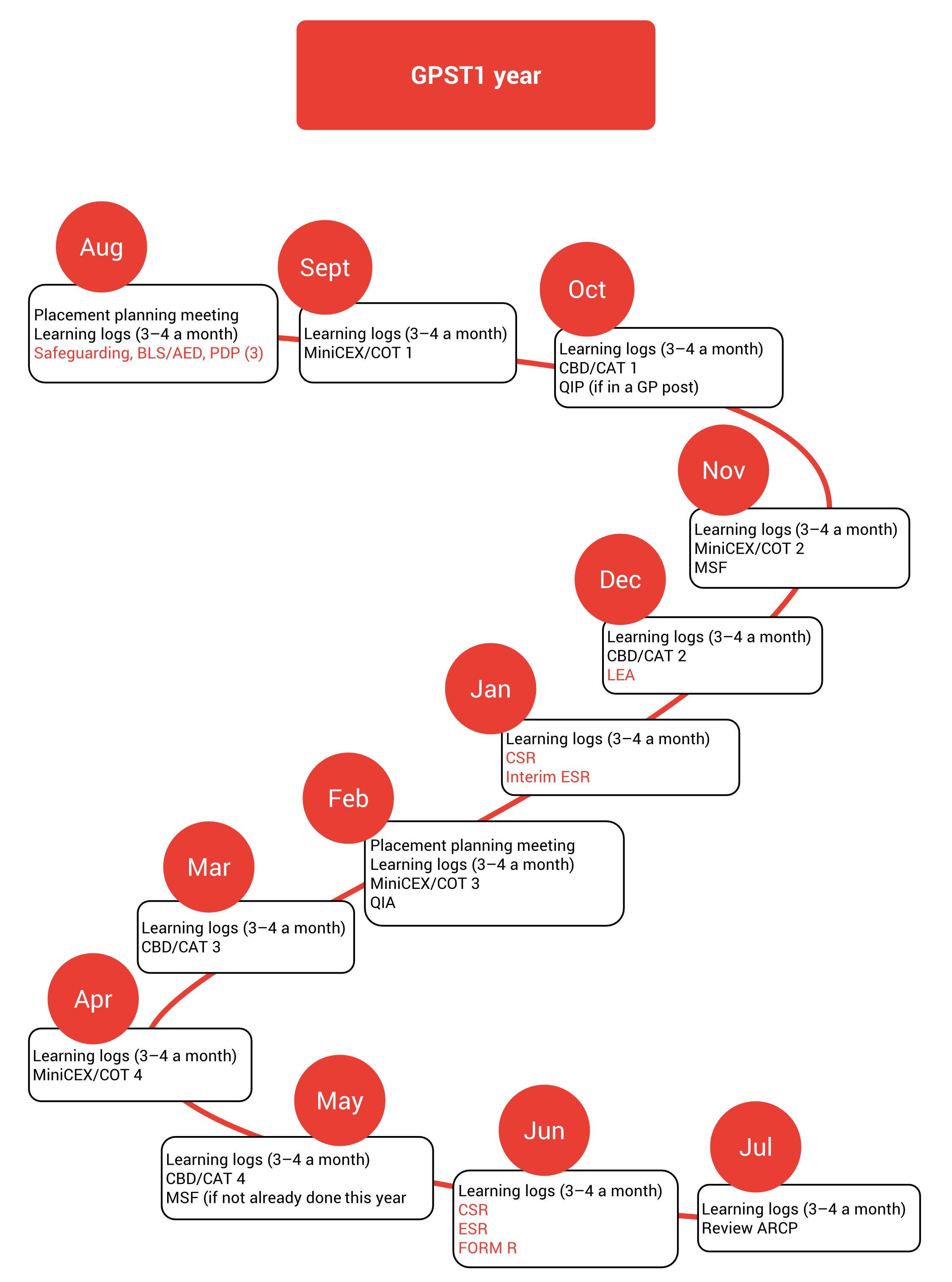
Planning the GPST1 year
Welcome to GP training!
The biggest tip for ST1s is to get to grips with the portfolio early on so that you can maximise the educational benefit and avoid rushing through outstanding assessments towards the end of the year.
Meet your educational and clinical supervisors early and ensure that they are linked to you on the portfolio.
So, what do you need to complete this year? We have come up with a suggested guide to help you through – with the least amount of stress and maximum benefit!
There are a few assumptions we’ve made here. Firstly, this guide is for a full-time trainee; if you are LTFT, the information here would need to be considered pro rata. In addition, this is designed for 2 x 6-month posts for every training year so, again, this may need adjusting for your local scheme.
%20demystified%20-%20GPST1.png?version=1)
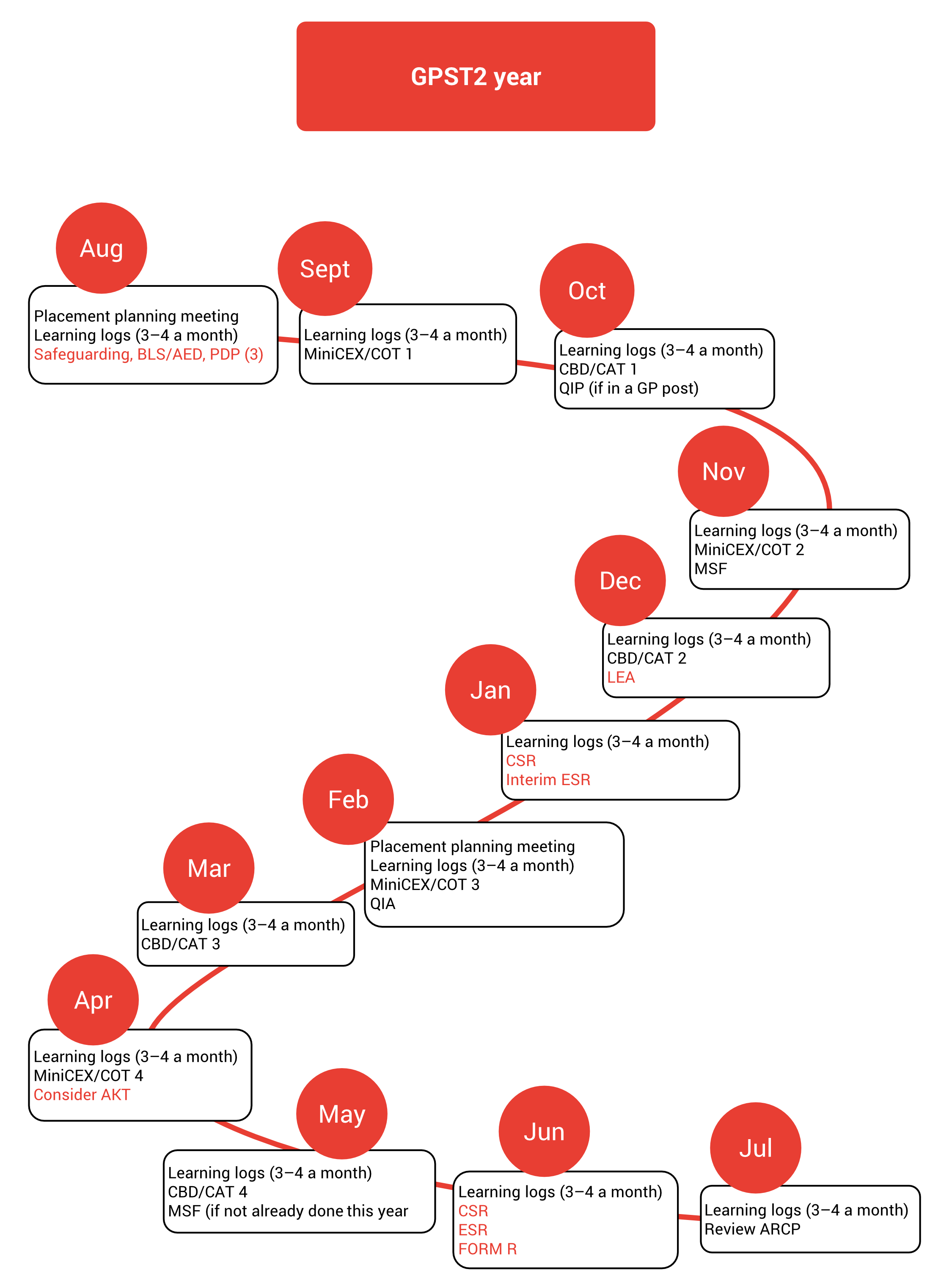
Planning the GPST2 year
By this year, you will have got the ball rolling with your portfolio, and should now be aware of any gaps within your capabilities and competencies.
With your learning logs, focus on the areas with gaps. Look to evidence the capabilities and competencies as best you can to provide an even distribution of evidence as you complete this year.
There are a few assumptions we’ve made here. Firstly, this guide is for a full-time trainee; if you are LTFT, the information here would need to be considered pro rata. In addition, this is designed for 2 x 6-month posts for every training year so, again, this may need adjusting for your local scheme.
So, what do you need to complete this year? Here’s our guide:
%20demystified%20-%20GPST2.png?version=1)
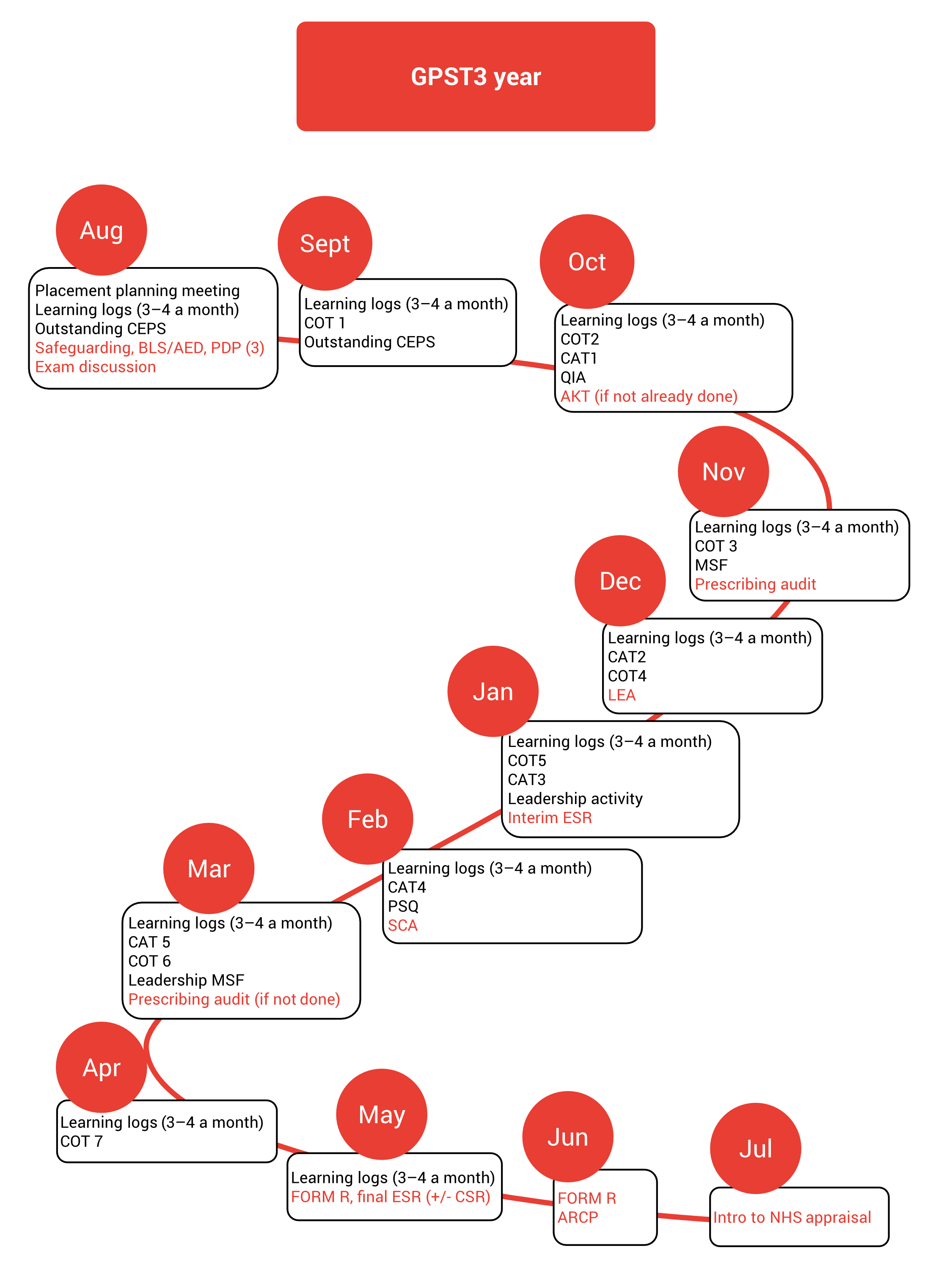
Planning for the GPST3 year
Here we are – the last year of training before CCT. How are you feeling? Excited? Apprehensive?
This is quite a busy year, so plan it early and discuss your plan with your trainer at your placement planning meeting. Think about what gaps you may have in your evidence. Have there been any issues in your ARCP that you can learn from?
Aim to distribute the WBPA capabilities through each month of training to ensure a smooth and unrushed finish!
So, what do you need to complete this year? Here’s our guide:
%20demystified%20-%20GPST3.png?version=1)
Face-to-face appointment length recommendation
Training stage |
Months after starting placement (whole-time equivalent) |
Suggested appointment time |
|
First GP placement or <6 months experience (GPST1 or GPST2) |
0 months (e.g. Aug or Feb) |
30 minutes (5–6 patients per session) |
| 2 months (e.g. Oct or April) |
20 minutes (7–8 patients per session) |
|
|
≥6 months of prior GP placement experience (GPST1 or GPST2) |
0 months (e.g. Aug or Feb) |
30 minutes (5–6 patients per session) |
| 2 months (e.g. Oct or April) |
20 minutes (7–8 patients per session) |
|
| 4 months (e.g. Dec or Jun) |
Consider 15 minutes (10–12 patients per session) |
|
| ST3 | 0 months (e.g. Aug) |
20 minutes (7–8 patients per session) |
| 3 months (e.g. Nov) |
15 minutes (10–12 patients per session) |
 |
Workplace-based assessment demystified
|
 |
Useful resources: Websites (all resources are hyperlinked for ease of use in Red Whale Knowledge) For the most up-to-date information on WPBA and the MRCGP, always refer to the official sites: |
This information is for use by clinicians for individual educational purposes, and should be used only within the context of the scope of your personal practice. It should not be shared or used for commercial purposes. If you wish to use our content for group or commercial purposes, you must contact us at sales@red-whale.co.uk to discuss licensing, otherwise you may be infringing our intellectual property rights.
Although we make reasonable efforts to update and check the information in our content is accurate at the date of publication or presentation, we make no representations, warranties or guarantees, whether express or implied, that the information in our products is accurate, complete or up to date.
This content is, of necessity, of a brief and general nature, and this should not replace your own good clinical judgment or be regarded as a substitute for taking professional advice in appropriate circumstances. In particular, check drug doses, side effects and interactions with the British National Formulary. Save insofar as any such liability cannot be excluded at law, we do not accept any liability for loss of any type caused by reliance on the information in these pages.
Here is the link to our terms of use.